Forex brokerage business plan: what to decide before you launch
The seven decisions every forex brokerage business plan should settle before launch: target market, offer, team, technology, payments, marketing and milestones.
 EVO PlatformsStarting a brokerage7 min read

A forex brokerage business plan should settle seven decisions before you launch: your target market, your offer, your team, your technology, your payments, your marketing and your milestones. If you can answer each one in a few clear sentences, with a name next to it, you have a plan your partners and your team can actually use.
This is not a template for a long document nobody reads. It is a working list of what to decide, in what order, and what a good answer looks like. For the step-by-step launch itself, see how to start a forex brokerage. This article is about the thinking you do first.
Key takeaways
- A forex brokerage business plan should settle seven decisions: target market, offer, team, technology, payments, marketing and milestones.
- Start with the target market, because it sets your languages, support hours, payment methods and first symbols.
- Give every function an owner, even if one person covers two roles at first.
- Plan payments early and write the approval rules down; they often take longer than technology.
- Tie milestones to outcomes. With EVO, the technology can be live in less than 24 hours, so your time goes to clients.
The plan on one page
Start with a single page. Every later section of your plan expands one line of this table, and if a line stays empty, that is your next job.
| Decision | The question to answer |
|---|---|
| Target market | Which clients, in which countries, speaking which languages? |
| Offer | What can they trade, on what conditions, and why choose you? |
| Team | Who sells, who keeps clients active, who handles money and risk? |
| Technology | Which platform, CRM, back office and price feed will you run? |
| Payments | How do clients deposit and withdraw, and who approves it? |
| Marketing | Where do leads come from, and how do you measure them? |
| Milestones | What must be true at each stage, and by when? |
1. Target market: who exactly are you serving?
"Traders worldwide" is not a target market. Name one or two countries or language groups, and describe your typical client in a short paragraph: their experience, what they want to trade, how they prefer to pay and where they spend time online.
This decision drives almost everything else. It sets your languages, your support hours, your payment methods and your first symbols. A brand built for Arabic-speaking clients needs a very different setup from one built for German-speaking clients, so settle this first and let the rest follow.
2. Offer: what you sell and why clients choose you
Your offer is more than a symbol list. Write down these four things:
- Markets. Which of forex, metals, indices, crypto, commodities and stocks you open with. Our guide to which markets a new broker should offer suggests a rollout order.
- Trading conditions. How you will price each symbol and what limits apply. Read how brokers earn before you decide.
- Risk rules. Your leverage approach, margin call and stop-out levels, and when an account gets suspended. Our guides to leverage settings and margin call and stop-out cover the detail.
- Your reason to exist. One sentence on why a client picks you: your language, your service, your payment options or your local presence.
With EVO, execution is in-house, and risk management is built in. In the back office you set spreads per symbol, limits per symbol and leverage per client, with margin call and stop-out handled automatically at your levels. Your plan should say who sets these values and who may change them. Risk groups and a dealing room are coming soon.
3. Team: the roles you need on day one
A new brokerage can start small, but every function needs an owner, even if one person covers two of them at first:
- Management. Owns the plan, the numbers and the final decisions.
- Sales. Turns new leads into funded clients.
- Retention. Looks after funded clients and keeps them active.
- Finance. Reviews every deposit and withdrawal.
- Client support. Answers questions in your clients' languages and hours.
- Risk. Watches positions and maintains your settings.
Write down who you hire first, who you add as leads grow, and which languages each role needs. EVO CRM maps directly to this: admin, team leader, sales agent and retention agent roles, with permissions that decide who can see and change what. For a closer look at desk design, read sales desk vs retention desk.
4. Technology: choose one system or manage several
The main choice is whether you assemble separate tools, build your own, or subscribe to a connected system. Our comparison of white label and building your own platform goes through the trade-offs, and the platform checklist for new brokers helps you compare providers.
Whichever route you take, your plan should answer these questions: who runs the servers, where client data sits, who can access it, how quickly you can go live, and who answers when something breaks at night.
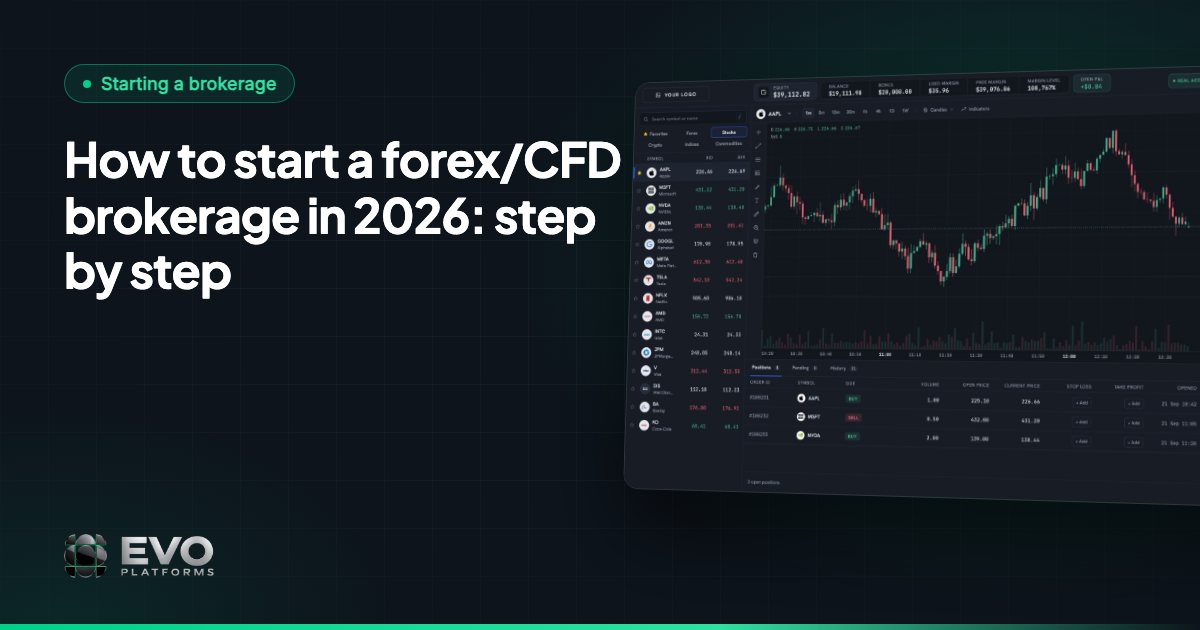
EVO is the connected route: EVO WebTrader, EVO CRM, the back office and the price feed with 250+ symbols, as one white-label system on a dedicated, isolated VPS, with IP whitelist and security logs. It is a flat monthly fee with no setup fee and no revenue share, and EVO plans start from $2,500 per month. That makes this line of your plan easy to forecast. See pricing for what is included.
5. Payments: how money moves and who signs off
Payments often take longer than technology, so give them their own section. Decide which methods your target market needs, whether USDT and other crypto, cards, bank transfer or local methods, and which you open with. Payment methods for forex brokers helps you choose, and PSP approval shows what providers usually ask for.
Then write your rules: who reviews deposits, who approves withdrawals, what your target response time is, and what happens with an unusual request. EVO can connect any payment method, and every deposit and withdrawal goes through an approval flow in the CRM, so these rules become a daily routine instead of a chat group.
6. Marketing: where your first clients come from
Choose two or three channels you can run well rather than ten you can't. Common options include search, paid ads, social media, content in your clients' language and local partners. For each channel, note who runs it and how you will judge it.
Measure the whole path, not just clicks. At minimum, track leads by source, funded clients and clients who stay active. EVO's optional broker website service builds a custom, SEO-ready site whose sign-ups land in EVO CRM automatically with their source, and CRM reports show how your desks and leads are performing.
7. Milestones: what done looks like at each stage
Tie milestones to outcomes rather than hopes. Give each one an owner and a date, and review them together at a fixed time each month.
| Stage | What done looks like |
|---|---|
| Ready to build | Target market, offer and provider chosen; payment conversations started. |
| Ready to launch | Brand, domain, website, and terms and policy pages ready; symbols and risk settings entered. |
| Ready for clients | Team invited with roles; a test deposit and withdrawal completed from start to finish. |
| First clients | Leads arriving by source, with every lead answered and owned. |
| First review | Results compared with the plan; weak channels cut, strong ones given more. |
Technology should not be the slowest line here. With EVO you can be live in less than 24 hours, which leaves your time for what only you can do: payments, team and marketing. Launching in 24 hours explains what to prepare, and the biggest mistakes new brokerages make shows what to avoid.
Turn your plan into a live brokerage
A good plan gets simpler as you go, and much of the technology line can be settled in one conversation. Send us your target market and languages, and we'll tell you what your setup looks like. Contact us, or message our team on Telegram at @evoplatforms, 24/7.
Frequently asked questions
What should a forex brokerage business plan include?
It should cover seven decisions: target market, offer, team, technology, payments, marketing and milestones. Each one needs a clear answer, an owner and a date, along with the running costs that follow from it.
What should I decide first when planning a brokerage?
Decide your target market first. The countries, languages and client types you choose set your support hours, payment methods, first symbols and marketing channels.
How long should a brokerage business plan be?
Long enough to answer each decision clearly. Start with one page that lists the seven decisions, then expand each line. A short plan your team uses is worth more than a long one nobody reads.
Which team roles does a new forex brokerage need?
You need owners for management, sales, retention, finance, client support and risk. One person can cover two functions at first. EVO CRM includes admin, team leader, sales agent and retention agent roles, with permissions for each.
How does EVO fit into a brokerage business plan?
EVO covers the technology line in one system: EVO WebTrader, EVO CRM, the back office and the price feed. It can be live in less than 24 hours for a flat monthly fee, with no setup fee and no revenue share. EVO plans start from $2,500 per month.
This article is for general information only and is not legal, tax or financial advice.
Ready to launch your brokerage?
Trading platform, CRM, back office and price feed — white-label and live in less than 24 hours.