7 biggest mistakes new brokerages make
The seven mistakes we see most often when a new brokerage launches, from stitching tools together to ignoring risk controls, payments and support, and the practical fix for each.
 EVO PlatformsStarting a brokerage7 min read

Starting a brokerage is exciting. You have a brand, a market you understand and a team ready to sell. But the first months decide a lot, and most of the problems new brokers run into are not bad luck. They are the same handful of avoidable decisions, repeated by brand after brand.
We work with brokers launching their first brand every week, and the patterns are clear. Below are the 7 biggest mistakes new brokerages make, why each one hurts, and what to do instead. If you are still planning, read our guide to starting a forex brokerage alongside this one.
Key takeaways
- A patchwork of tools from different vendors creates gaps between the website, CRM, platform and payments; one connected system avoids them.
- Launching fast matters: EVO goes live in less than 24 hours, so you learn from real clients instead of waiting on setup.
- Set risk controls before the first trade: spreads and limits per symbol, leverage per client, margin call and stop out, and account controls.
- Every lead needs a source, status and owner, and every deposit and withdrawal needs an approval flow in the CRM.
- Security and support are part of the launch: isolated VPS, IP whitelist, security logs, and 24/7 Telegram support in English, Arabic and German.
1. Building a patchwork of tools
The most common mistake is also the most expensive over time: buying a trading platform from one vendor, a CRM from another, a price feed from a third and running payments through spreadsheets and chat groups. Each tool might be fine on its own. Together, they create gaps.
A client registers on the website but never appears in the CRM. A deposit is approved in one place and never credited in another. Your team logs into four systems, and nobody has the full picture of a client. Every integration between vendors is one more thing that can break, and one more support ticket bounced between companies.
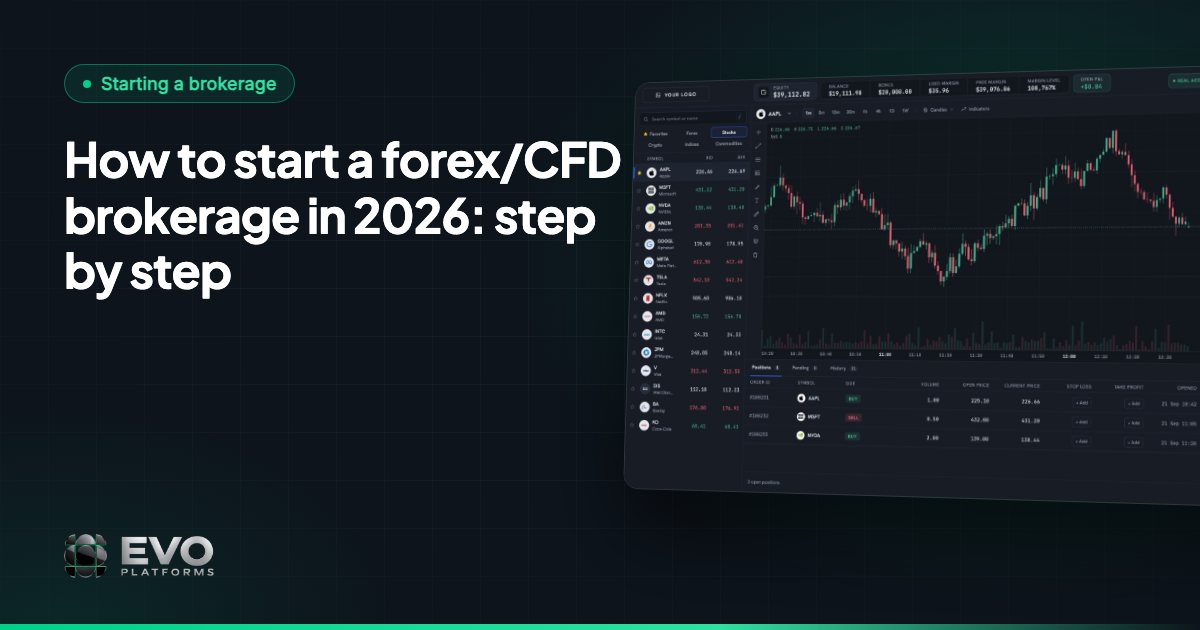
The fix: choose one system where the website, the CRM, the back office, the trading platform and the price feed are connected from day one. With EVO Platforms, EVO WebTrader, EVO CRM, the back office and the price feed are one white-label system: no second login, and no data to copy between tools.
2. Spending months on setup instead of launching
Many new brokers treat the technology as a long project: weeks of calls with vendors, a custom build, endless testing, and a launch date that keeps moving. Meanwhile, the marketing plan waits, the sales team waits and the market moves on.
Time is your scarcest resource at the start. Every week spent on setup is a week without clients, feedback or revenue to learn from. The brokers who grow fastest are usually the ones who get live quickly, then improve based on what real clients do.
The fix: pick a ready-made platform you can launch on now and customise later. EVO goes live in less than 24 hours: you pay, we deploy on your own server with your brand, domain and languages, and you can start onboarding clients the next day. Our 24-hour launch guide shows exactly what happens in that time.
3. Treating risk controls as an afterthought
New brokers often focus on marketing and leave risk settings at their defaults. Then a volatile session arrives, a few large positions move sharply, and the team discovers it has no quick way to adjust spreads, cap a symbol or change leverage for one client.
Risk controls are not something to configure after a bad day. They should be set, understood and reviewed before the first client trades. At a minimum, you should be able to manage:
- Spreads per symbol, so each instrument is priced the way you intend.
- Limits per symbol, to control volume and trading on each instrument.
- Leverage per client, instead of one setting for everyone.
- Margin call and stop out levels, handled automatically, for example a margin call at a margin level of 100% and a stop out at 50%.
- Account controls: suspend an account so the client cannot trade, deposit or withdraw, or disable it so they cannot log in at all.
In EVO, all of this lives in the back office inside EVO CRM, with in-house execution and risk management built in. Risk groups and a dealing room for your dealers are coming soon.
4. Letting leads fall through the cracks
New brokers spend heavily on traffic, then lose the leads it brings. Sign-ups sit in an inbox, two agents call the same person, nobody knows which campaign a lead came from, and a client who funded last month never hears from the retention team again.
The fix: a CRM where every website registration arrives automatically with its source, and every lead has a status, comments and one owner. EVO CRM handles 20,000+ leads, with separate sales and retention desks, roles for admin, team leader, sales agent and retention agent, an activity log per lead and reports on how your desks are performing. Follow-up reminders by lead status are coming soon.
5. Offering too few payment methods, with no approval flow
A client who wants to deposit and cannot find a method they use is a client you lose. Many new brokers launch with a single payment method, then discover that their target market prefers crypto, or a local method, or bank transfer.
The second half of the mistake is control. Without a clear approval flow, deposits and withdrawals are handled by message and memory, which invites errors and disputes.
The fix: offer the methods your clients actually use, and route every transaction through one process. With EVO you can take USDT and other crypto, cards, bank transfer or local payment methods, and any method can be connected. Every deposit and withdrawal goes through an approval flow in the CRM, so your team reviews each transaction before it is approved. Read more in our guide to forex broker payment methods.
6. Leaving access and security wide open
Small teams often share logins, give everyone full access and run on shared infrastructure without thinking twice. It works until a former employee still has access, a client list leaks or nobody can explain who changed an account setting.
The fix: treat security as part of the launch, not a later upgrade. On EVO, every broker runs on a dedicated, isolated VPS. You can whitelist the IP addresses allowed into the CRM and back office, use roles and permissions to decide who sees and changes what, and check the security logs, which record every click and action by CRM users and clients: who, what, when and from which IP. See our article on broker platform security for more.
7. Ignoring support and the languages your clients speak
Markets do not close for your vendor's office hours. If the platform has an issue late at night and your provider answers the next afternoon, your clients feel it first. The same applies to language: a platform that only works well in English is a hard sell in Arabic-speaking markets.
The fix: ask every vendor how fast they respond, through which channel and at what hours, and test it before you sign. EVO support is 24/7 and Telegram-first at @evoplatforms, and we monitor every broker's platform around the clock. The platform runs in English, Arabic with full right-to-left support, and German, and we add any other language you need.
A quick pre-launch checklist
Before you go live, run through the seven mistakes as a checklist:
| Mistake | What to check before launch |
|---|---|
| Patchwork of tools | Website, CRM, back office, platform and price feed are connected |
| Slow launch | You have a realistic go-live date measured in days, not months |
| Risk as an afterthought | Spreads, symbol limits, leverage, margin call and stop out are set |
| Lost leads | Every sign-up lands in the CRM with a source, status and owner |
| Too few payment methods | The methods your market uses are live, with an approval flow |
| Open access | Roles, IP whitelist and security logs are in place |
| Weak support | You know who answers at 3 a.m., and in which language |
Avoiding these mistakes with EVO
EVO was built for exactly this moment. Every plan includes the branded EVO WebTrader for desktop and mobile browsers, EVO CRM with the back office and risk controls, a real-time price feed with 250+ symbols streamed with no delays and any symbol added on request, 24/7 digital currency feeds, a dedicated VPS and 24/7 support. We can also build your broker website, connected straight to the CRM.
EVO plans start from $2,500 per month. See pricing for what is included, or contact us and message @evoplatforms on Telegram to see the platform before you launch.
Frequently asked questions
What is the biggest mistake new brokerages make?
The most common one is building a patchwork of tools from different vendors. The gaps between the website, CRM, trading platform and payments cause lost leads, slow deposits and support issues. A single connected system like EVO avoids most of them.
How quickly can a new brokerage launch on EVO?
In less than 24 hours. You pay, we deploy the white-label WebTrader, CRM, back office and price feed on your own dedicated server, and you can start onboarding clients the next day.
Which risk controls should a new broker set before launch?
At a minimum: spreads and limits per symbol, leverage per client, margin call and stop out levels, TP and SL handling, and the ability to suspend or disable accounts. All of these are in the EVO back office. Risk groups and a dealing room are coming soon.
Which payment methods can a new brokerage offer on EVO?
Any method: USDT and other crypto, cards, bank transfer or local payment methods. Any method can be connected, and every deposit and withdrawal goes through an approval flow in EVO CRM.
How much does it cost to start with EVO?
EVO plans start from $2,500 per month. See the pricing page for what each plan includes.
This article is for general information only and is not legal, tax or financial advice.
Ready to launch your brokerage?
Trading platform, CRM, back office and price feed — white-label and live in less than 24 hours.