Forex payment providers (PSPs): why they reject you and how to get approved
Payment providers see forex as high risk, and many applications fail on avoidable details. Here is what PSPs look for, why brokers get rejected, and how to prepare an application that gets approved.
 EVO PlatformsStarting a brokerage7 min read
For many brokers, the hardest part of launching is not the trading platform or the marketing. It is getting a payment service provider (PSP) to say yes. Applications are rejected, accounts are approved and then closed, or onboarding drags on for weeks with no clear answer.
The good news is that most rejections come from a short list of issues you can prepare for. This guide explains why PSPs treat forex as high risk, the most common reasons they reject brokers, and the practical steps that make an application stronger, from your website to your KYC process to the payment methods you offer.
Key takeaways
- PSPs usually classify forex and CFD trading as high risk, so they need more evidence that your business is organised and in control of payments.
- Most rejections come from fixable issues: incomplete website policies, unclear KYC and AML steps, no chargeback plan and unrealistic volumes.
- Publish terms, risk warnings, privacy and refund policies, and keep your application consistent with your website.
- Show monitoring in practice: an approval flow for every deposit and withdrawal, account suspension, and security logs as an audit trail.
- Don't depend on one provider: combine USDT and crypto, local methods, bank transfer and cards; EVO can connect any method.
Why forex counts as high risk for payment providers
A PSP takes on risk every time it processes a payment for you. If clients dispute transactions, if funds are linked to fraud, or if the business behaves differently from what was described at onboarding, the provider carries part of the problem. That is why most providers sort merchants into risk categories, and forex and CFD trading usually falls into the high-risk category.
The reasons are well known: trading involves real losses, which can lead to disputes; deposits are often larger and more frequent than in ordinary e-commerce; clients come from many countries; and the industry has a history of chargebacks and complaints. None of this means approval is impossible. It means the provider needs more evidence that your business is organised, transparent and in control of its payments.
The most common reasons PSPs reject brokers
Every provider is different, but the same issues appear again and again in rejected applications:
- An incomplete website: missing terms, risk warnings, privacy or refund pages, or no clear contact details.
- No visible client checks: the provider cannot see how you verify clients or review suspicious activity.
- No plan for disputes: nothing explains how refunds, withdrawals and chargebacks are handled.
- Unrealistic volumes: projections that look inflated or do not match the size of the team and marketing plan.
- A vague business picture: unclear target markets, products or client journey.
- Inconsistent information: the application says one thing and the website says another.
Each of these is fixable before you apply. The sections below go through them one by one.
Get your website ready before you apply
The first thing most underwriters check is your website. It should look like a real, operating brokerage, not a placeholder. Before you apply, make sure it includes:
- Terms and conditions that describe accounts, deposits, withdrawals and trading rules.
- A clear risk warning on every page, explaining that trading leveraged products carries a high level of risk.
- A privacy policy that explains how client data is collected and used.
- A refund and withdrawal policy that sets out how and when clients can get their money back.
- Account types and trading conditions that match what you tell the provider.
- Contact details and support channels that actually work.
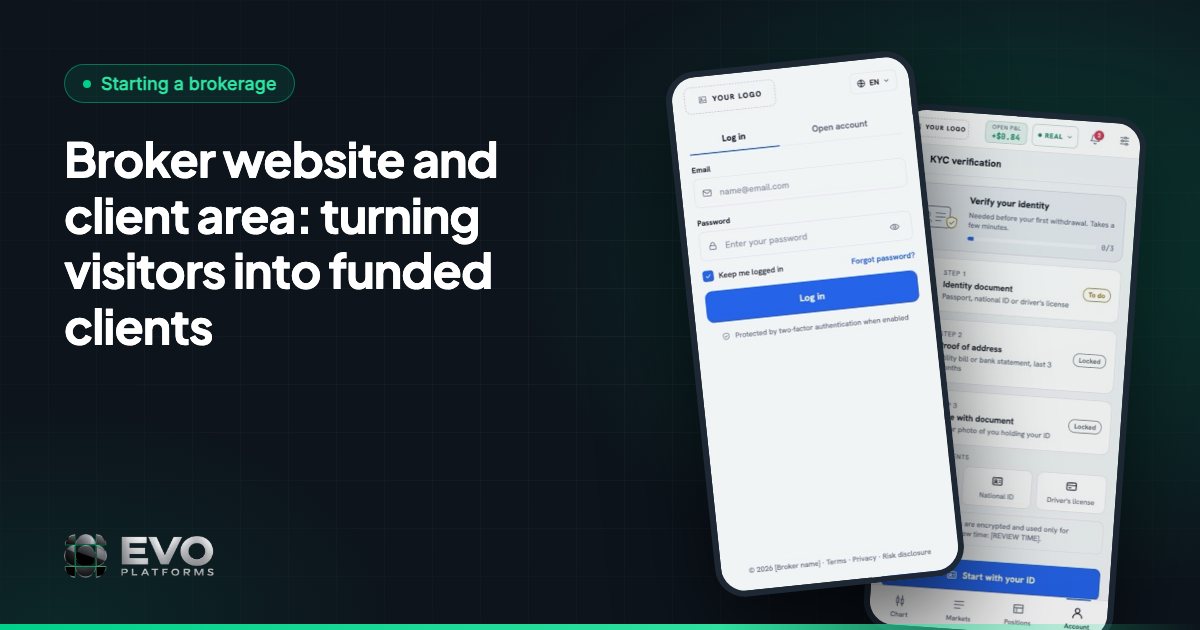
If you need a site, we build custom broker websites in your brand, with account types, trading conditions, education and terms and policy pages, in English, Arabic and German, and every sign-up goes straight into EVO CRM. See our guide to the broker website and client area for what a complete site includes.
Show clear KYC and AML procedures
Providers want to know who is paying through them. Describe your KYC (know your customer) and AML (anti-money laundering) process in plain steps: what documents clients upload, who reviews them, when an account is allowed to deposit and withdraw, and what happens when something looks wrong.
It helps when the process is visible in your platform, not only on paper. In EVO WebTrader, the client area includes KYC documents next to profile, security, deposits, withdrawals and transaction history, so verification is part of the client journey. Your team then manages clients and their accounts inside the CRM and the back office.
An integrations page to connect payment and KYC / AML providers by API key, and a modular setup to switch KYC, document signing and AML checks on or off, are coming soon. Integrations with a specific provider can be built today as custom development.
Have a plan for refunds and chargebacks
Chargebacks are one of the main reasons providers close high-risk merchants. A chargeback happens when a cardholder disputes a payment with their bank, and too many of them can put your account at risk. Show the provider that you work to prevent them:
- 1Publish a clear refund and withdrawal policy and follow it consistently.
- 2Verify clients before they deposit larger amounts, so payments match the account holder.
- 3Make withdrawals easy to request and track, so clients do not turn to their bank instead.
- 4Respond to complaints quickly through support before they become disputes.
- 5Keep records of every transaction, approval and client action, ready for any dispute.
Some high-risk providers may also apply extra conditions, such as holding part of the processed funds for a period. Ask about this early, and check the provider's current offer before you commit.
Show you can monitor transactions
Providers are more comfortable when they know you review payments, not just accept them. In EVO, every deposit and withdrawal goes through an approval flow in the CRM, so your team reviews each transaction before it is approved. Client accounts are linked to their trading accounts, so finance sees the full context of every request.
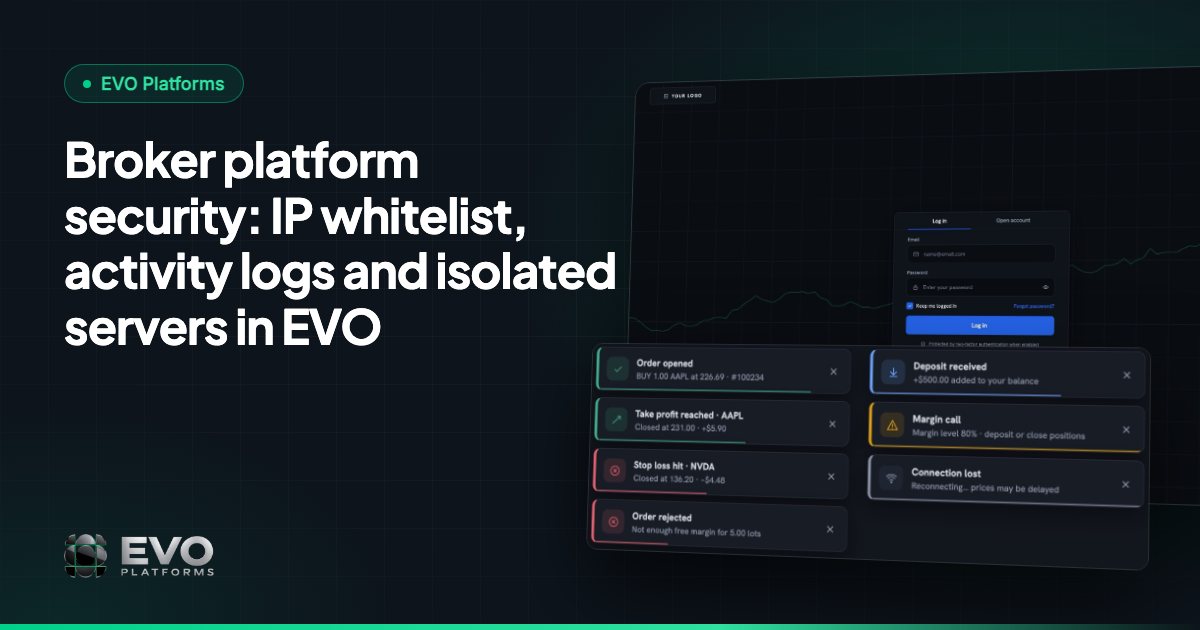
When something looks wrong, you can act immediately. You can suspend an account so the client can log in and see it but cannot trade, deposit or withdraw, or disable it so they cannot log in at all. Security logs record every click and action by CRM users and clients, with who, what, when and from which IP, which gives you a clear audit trail if a provider asks questions. Read more in our article on broker platform security.
Give realistic volumes and a clear business picture
It is tempting to promise big numbers to look attractive. In practice, inflated projections are a red flag. A provider compares your expected volume with your team, your marketing plan and your website, and if they do not fit together, the application looks risky.
Be specific and honest instead: which countries you target, how you acquire clients, which products clients trade, the typical deposit pattern you expect and how withdrawals work. Starting with modest, believable volumes and growing them with a clean track record is usually easier than asking for large limits on day one.
Don't rely on one provider: crypto, USDT and local methods
Even with a strong application, card approval can take time. Smart brokers do not wait on a single provider. They combine several methods so clients can always fund their accounts:
| Method | Why brokers use it |
|---|---|
| USDT and other crypto | Works around the clock and across borders, familiar to active traders |
| Local payment methods | Methods clients already use daily in their country |
| Bank transfer | Expected by many traditional clients |
| Cards | Familiar and fast for clients once a provider is in place |
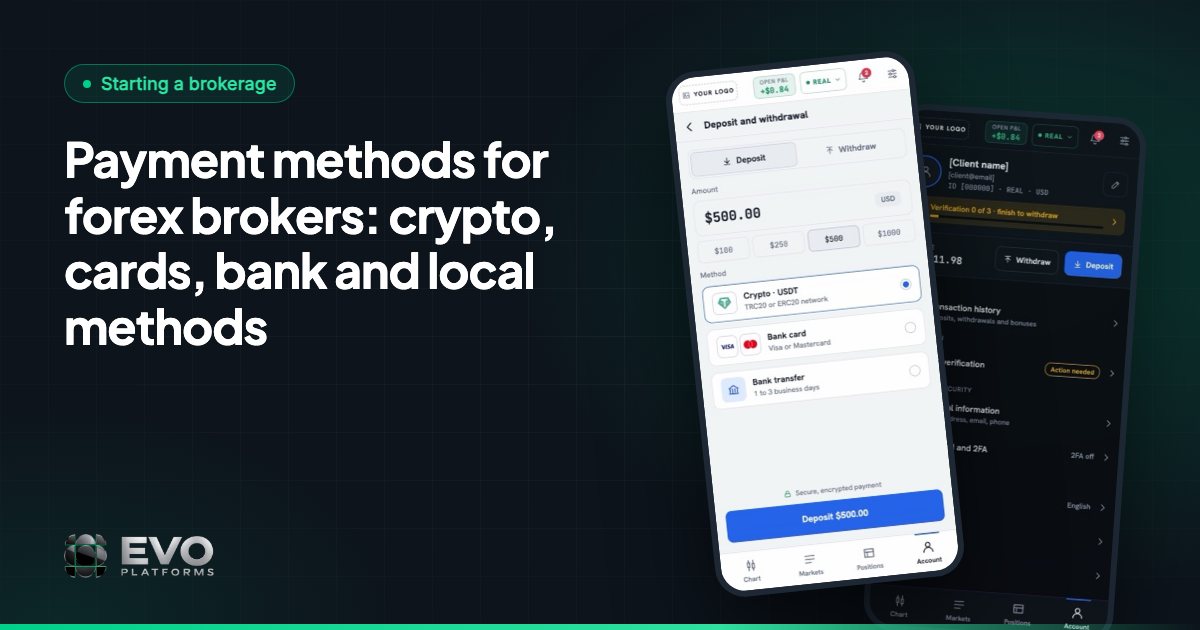
With EVO, clients can deposit by any payment method: USDT and other crypto, cards, bank transfer or local methods. Any method can be connected, and all of them run through the same approval flow. Our guide to forex broker payment methods compares them in more detail.
How EVO fits into your payments setup
EVO is a SaaS technology provider: we do not hold client funds or process payments ourselves. What we give you is the system around your payments. The branded client area takes deposit and withdrawal requests and KYC documents, EVO CRM routes every transaction through approval, and the back office gives you account controls, roles and permissions, IP whitelist and security logs. If you work with a specific payment gateway, we can build the integration as custom development.
EVO goes live in less than 24 hours on a dedicated, isolated VPS, in English, Arabic and German, with 24/7 support on Telegram at @evoplatforms. EVO plans start from $2,500 per month; see pricing, or contact us to talk through your payment setup.
Frequently asked questions
Why do payment providers reject forex brokers?
Most providers place forex and CFD trading in a high-risk category because of disputes, chargebacks and cross-border payments. Applications are then often rejected for fixable reasons, such as missing website policies, unclear KYC and AML procedures, no refund or chargeback plan, or volumes that look unrealistic.
Which pages should a broker website have before applying to a PSP?
Terms and conditions, a clear risk warning, a privacy policy, a refund and withdrawal policy, account types and trading conditions, and working contact details. EVO can build a custom broker website with terms and policy pages, connected to EVO CRM.
Does EVO process payments or hold client funds?
No. EVO is a SaaS technology provider. We provide the client area, the CRM approval flow and the back office around your payments, and we can connect any payment method or build a gateway integration as custom development.
What can a broker offer while waiting for card approval?
Many brokers start with USDT and other crypto, local payment methods and bank transfer. With EVO, any method can be connected, and every deposit and withdrawal goes through the same approval flow in the CRM.
Can EVO connect KYC and AML providers?
Integrations with a specific provider can be built as custom development today. An integrations page to connect payment and KYC / AML providers by API key, and a modular setup for KYC, document signing and AML checks, are coming soon.
This article is for general information only and is not legal, tax or financial advice.
Ready to launch your brokerage?
Trading platform, CRM, back office and price feed — white-label and live in less than 24 hours.