Payment methods for forex brokers: crypto, cards, bank and local methods
Crypto, cards, bank transfer or local methods: how forex brokers choose payment methods, why USDT deposits are popular, and how deposits and withdrawals flow through EVO CRM with an approval step.
 EVO PlatformsStarting a brokerage7 min read
A client who cannot fund their account is a client who never trades. For a forex or CFD brokerage, payment methods are not a back-office detail. They decide how many sign-ups become funded accounts, and how much your clients trust you when they ask for their money back.
This guide covers the main forex broker payment methods, from USDT and other crypto to cards, bank transfer and local methods, how to choose the right mix for your markets, and how deposits and withdrawals work inside EVO CRM on EVO Platforms.
Key takeaways
- Payment methods decide how many sign-ups become funded accounts, and how much clients trust you at withdrawal time.
- Most brokers combine USDT and crypto, cards, bank transfer and local methods, chosen by the markets their clients come from.
- USDT deposits work around the clock and pair well with EVO's 24/7 digital currency feeds.
- On EVO, any payment method can be connected, and every deposit and withdrawal goes through an approval flow in EVO CRM.
- Suspended and disabled accounts, roles and permissions, IP whitelist and security logs put controls around every transaction.
Why payment methods matter for a brokerage
Your sales desk can do everything right, then the client reaches the deposit page and the method they use every day is not there. The lead goes cold, and the cost of acquiring them is lost.
Payment methods affect three things at once:
- Conversion. The more familiar the deposit option, the more sign-ups become funded accounts.
- Trust. Clients judge a broker by how easy it is to deposit, and even more by how smoothly withdrawals are handled.
- Operations. Every method has to be reviewed, recorded and reconciled by your finance team, so the way transactions reach you matters as much as the methods themselves.
That is why the best brokers think about payments as a full flow, from the client's first deposit to an approved withdrawal, not as a list of logos on a page.
The main broker deposit methods
Most brokerages combine several of the following. Each has its own strengths, and the right mix depends on where your clients are.
USDT and other crypto
Stablecoins such as USDT have become one of the most common ways to fund a trading account. Transfers are not tied to banking hours, they work across borders, and many active traders already hold crypto.
Cards
Debit and credit cards are familiar to almost everyone, which makes them a strong option for first-time traders. The experience is quick for the client, and the method needs little explanation from your sales team.
Bank transfer
Bank transfers suit clients who prefer to move larger amounts through their own bank, and they are often expected by more traditional clients. They are usually slower than cards or crypto, so clear instructions on the deposit page help.
Local payment methods
In many regions, clients prefer a local method they use for everyday payments. Offering it can make a real difference to conversion in a specific country, especially when your sales desk focuses on that market.
| Method | Typical strengths | Things to plan for |
|---|---|---|
| USDT / crypto | Available around the clock, works across borders, familiar to active traders | Clear wallet instructions and careful review of each transaction |
| Cards | Familiar, quick for the client | Not every client or region uses cards for trading |
| Bank transfer | Suits larger amounts and traditional clients | Usually slower, needs clear payment details |
| Local methods | Strong conversion in specific countries | Choose them per market, based on where your leads come from |
USDT deposits for brokers
USDT deserves its own section because so many brokers now treat it as a default option. For clients, it is a fast way to fund an account at any time of day. For brokers, it removes a lot of friction for clients in regions where other methods are hard to use.
Crypto deposits also fit naturally with crypto trading. EVO's price feed streams digital currency prices 24/7, weekends included, so clients who deposit in USDT on a Saturday can trade crypto symbols straight away.
The key is control on your side. Every USDT deposit and withdrawal should be visible to finance, checked and approved before it changes a client's balance. In EVO, that is exactly how the flow works: each transaction arrives in the CRM with a status such as waiting for approval, approved or rejected.
How deposits and withdrawals work in EVO
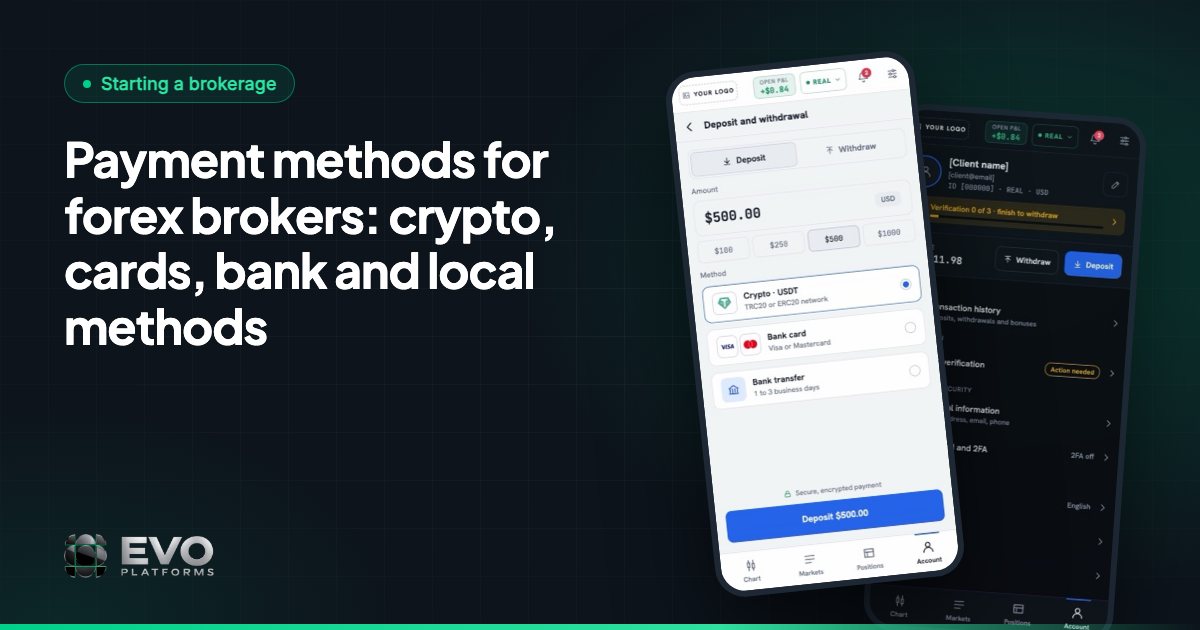
On EVO Platforms, clients can fund their accounts by any payment method: USDT and crypto, cards, bank transfer or local methods. Any method you need can be connected. What stays the same is the way every transaction is handled:
- 1The client requests a deposit or withdrawal from the client area in EVO WebTrader, where they also manage their profile, security, KYC documents and transaction history, all in your brand.
- 2The transaction lands in EVO CRM, linked to the client and their trading account, so your team sees who is paying and into which account.
- 3Finance reviews it in the approval flow and approves or rejects it. Nothing is applied without sign-off.
- 4The client is notified, and the transaction appears in their history.
Because payments sit inside the same system as your leads and clients, your sales and retention desks see who has funded and who has not, without asking finance for a spreadsheet. For more on how the CRM side works, see our guide to EVO CRM and the back office.
Account controls and security around payments
Payments are where mistakes and misuse are most expensive, so EVO puts controls around them in the back office:
- Suspended accounts. The client can log in and see the account, but cannot trade, deposit or withdraw while you review it.
- Disabled accounts. The client cannot log in to the account at all.
- Roles and permissions. Decide who on your team can see transactions and who can approve them.
- IP whitelist. Allow access to the CRM and back office only from the IP addresses you approve.
- Security logs. Every click and action by CRM users and clients is logged: who, what, when and from which IP.
Each broker also runs on its own isolated server, a dedicated VPS, so your clients' transaction data never touches another broker's.
Connecting the payment methods you need
Brokers rarely use exactly the same providers, so EVO does not lock you into a fixed list. Tell us which methods you want to offer and we connect them. If a specific gateway needs a dedicated integration, our custom development team builds it on top of EVO, quoted up front.
An integrations page, where you connect payment, KYC and other providers by pasting API keys, is coming soon.
How to choose the right mix for your brokerage
There is no single best list of methods. A practical way to decide:
- 1Start from your markets. Look at the countries your leads come from and what clients there use every day.
- 2Cover the basics. Most brokers start with USDT, cards and bank transfer, then add local methods per market.
- 3Plan withdrawals, not only deposits. Clients judge you on how withdrawals are handled, so make sure every method has a clear path back.
- 4Keep one approval flow. However many methods you add, route them through the same review in the CRM.
- 5Review regularly. Use your CRM reports to see which methods your funded clients actually use, and adjust.
Launching a new brokerage? Payment methods are one of the first decisions; our guide to launching a forex brokerage covers the other steps.
EVO plans start from $2,500 per month and include EVO WebTrader, EVO CRM with the back office, the price feed and 24/7 support. See pricing, or contact us to talk through the payment methods you want to offer.
Frequently asked questions
Which payment methods can clients use on EVO?
Any payment method: USDT and other crypto, cards, bank transfer or local methods. Any method you need can be connected, and every deposit and withdrawal goes through an approval flow in EVO CRM.
Can a broker accept USDT deposits on EVO?
Yes. USDT is one of the most common methods brokers offer on EVO. Each USDT deposit or withdrawal arrives in the CRM and is approved or rejected by your finance team.
How are withdrawals approved?
Withdrawal requests from the client area land in EVO CRM, linked to the client and their trading account. Finance reviews each one in the approval flow before it is processed, and the client sees it in their transaction history.
Can you connect a payment gateway we already use?
Yes. Tell us which method or gateway you use and we connect it. Where a dedicated integration is needed, it is built as custom development on top of EVO.
Can I stop a client from depositing or withdrawing?
Yes. A suspended account can still log in and see the account, but cannot trade, deposit or withdraw. A disabled account cannot log in at all.
This article is for general information only and is not legal, tax or financial advice.
Ready to launch your brokerage?
Trading platform, CRM, back office and price feed — white-label and live in less than 24 hours.