What is a CFD broker and how does a brokerage work?
What a CFD broker is, how a forex or CFD brokerage runs from first sign-up to withdrawal, how it earns, and the teams and systems behind it.
 EVO PlatformsStarting a brokerage7 min read
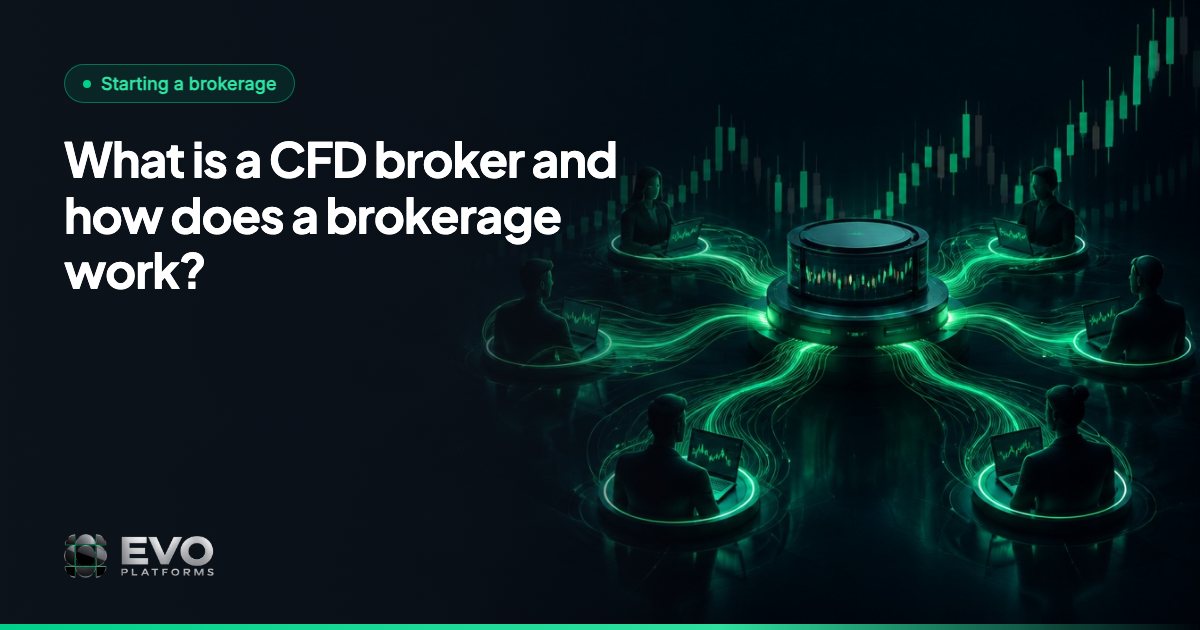
A CFD broker is a company that lets clients trade contracts for difference: agreements that follow the price of a market, such as gold, an index or a currency pair, without the client owning the asset itself. A brokerage works by giving clients a trading platform and live prices, taking their deposits, executing their orders and earning mainly from trading fees such as the spread.
This guide breaks that down for anyone thinking about launching a brokerage or joining one: what a CFD is, how a brokerage runs from first sign-up to withdrawal, how it earns, and which teams and systems sit behind it.
Key takeaways
- A CFD broker lets clients trade on the price of a market without owning the asset.
- A brokerage runs one loop: marketing, sign-up, verification, deposit, trading, retention and withdrawal.
- Income follows trading activity through spreads and other trading fees, so long-term active clients matter most.
- Brokerages depend on six connected systems: platform, price feed, CRM, back office, website and payments.
- EVO supplies these systems in your brand, live in less than 24 hours. EVO plans start from $2,500 per month.
What is a CFD?
CFD stands for contract for difference. Two sides agree to settle the difference between a market's price when a position opens and its price when the position closes. If a client buys and the price rises, the position shows a profit. If the price falls, it shows a loss. A client can also sell first, expecting the price to fall.
The client never receives a barrel of oil or a share certificate, and that is what makes CFDs flexible. One account can trade forex, metals, indices, crypto, commodities and stocks from a single screen. Our guide to which markets a new broker should offer covers each group.
Most CFDs are traded with leverage, which means the client sets aside only part of the position's value as margin. At 1:100, for example, the margin is one hundredth of the position's value. Leverage magnifies gains and losses alike, so every brokerage needs clear rules for it, as we explain in leverage settings for brokers.
CFD broker vs forex broker: what is the difference?
In everyday use the two overlap. A forex broker is known mainly for currency pairs, while a CFD broker offers a wider range of markets. Many firms offer both on the same platform, which is why people often say forex/CFD brokerage. A traditional stock broker is different: there, the client buys and owns the shares.
| Question | Forex broker | CFD broker | Traditional stock broker |
|---|---|---|---|
| Main products | Currency pairs | Forex, metals, indices, crypto, commodities and stocks | Shares and funds |
| Does the client own the asset? | Usually no, for leveraged trading | No | Yes |
| Is leverage central? | Yes | Yes | Usually less so |
How does a forex or CFD brokerage work, step by step?
Whatever its size, every brokerage runs the same loop:
- 1Marketing brings a visitor. Ads, content and partners lead people to the website.
- 2The visitor registers. The sign-up becomes a lead in the CRM, and a sales agent follows up.
- 3The client verifies. Identity documents go through KYC verification.
- 4The client deposits. Funds arrive through one of the broker's payment methods, and finance approves the transaction.
- 5The client trades. The platform streams live prices, takes orders and tracks balance, equity and margin.
- 6Retention takes over. A retention agent stays in touch with funded clients.
- 7The client withdraws. The request goes through approval and the funds are paid out.
What happens when a client places a trade?
The client presses Buy or Sell and can attach a take profit and a stop loss. The system checks that the account has enough free margin and opens the position at the live price, and profit or loss then updates with every price change. If equity falls too far, a margin call alerts the client and a stop out closes positions automatically. We walk through the numbers in margin call and stop out explained.
How does a brokerage earn money?
A brokerage's income follows trading activity. The usual sources are:
- Spread: the gap between the buy and sell price on each symbol.
- Commission: a fee per trade, charged on some account types.
- Swap: a charge or credit for holding a position overnight.
Because income follows activity, a brokerage does best with clients who stay active over the long term. That makes fair pricing, a reliable platform and good service commercial priorities, not just nice extras. For the full breakdown, read spread, commission and swap: how a brokerage earns.
Who works inside a brokerage?
Small brokerages combine these roles, and larger ones give each its own team. The jobs stay the same:
| Team | What it does |
|---|---|
| Marketing | Brings visitors and leads through ads, content and partners |
| Sales desk | Turns new leads into funded clients |
| Retention desk | Looks after funded clients and keeps them active |
| Finance | Reviews deposits and withdrawals |
| Risk | Sets spreads, limits and leverage, and watches open positions |
| Client support | Answers questions about accounts and verification |
| Management | Sets targets, roles and permissions, and reads the reports |
The split between the two client-facing desks matters more than it first appears. We cover it in sales desk vs retention desk.
Which systems does a brokerage run on?
Behind those teams sit six systems. Each one has to talk to the others, or staff end up copying data by hand:
- Trading platform: where clients watch prices, place orders and follow their positions.
- Price feed: the live quotes that drive the platform.
- CRM: leads, desks and client records. New to the term? Start with what a CRM is for brokers.
- Back office: accounts, symbols, spreads, leverage and risk controls.
- Website and client area: where visitors sign up, verify and manage their money.
- Payments: the methods clients use to deposit and withdraw, with a review step for finance.
How does a brokerage manage risk?
Clients trade with leverage in markets that can move quickly, so a brokerage has to watch its own exposure as well as each client's account. In daily work, risk management comes down to a few settings: the spread on each symbol, volume and trading limits, the leverage each client receives, and the margin call and stop out levels. Staff also need to be able to pause an account that needs a review. Without these controls in one place, problems surface too late.
What does it take to start a CFD brokerage?
The main building blocks are a clear target market, a set of symbols that suits those clients, payment methods they trust, a technology stack, and a small team for sales, finance and support. Our guide on how to start a forex brokerage walks through the steps in order.
How EVO supports a CFD brokerage
EVO Platforms is a technology provider, not a broker: we do not hold client funds or provide financial services. We supply the systems above as one white-label product, in your brand, so clients never see the EVO name:
- EVO WebTrader for desktop and mobile browsers, with a watchlist, charts, a simple order box and a client area.
- A price feed with 250+ symbols, real-time streaming with no delays, any symbol on request and 24/7 digital currency feeds.
- EVO CRM with leads, sales and retention desks, and deposits and withdrawals in an approval flow.
- A back office with in-house execution and built-in risk management: spreads per symbol, symbol limits, leverage per client, margin call and stop out, take profit and stop loss, and suspended or disabled accounts. Risk groups and a dealing room are coming soon.
- Any payment method: USDT and other crypto, cards, bank transfer or local methods.
- A dedicated, isolated VPS per broker, with an IP whitelist and security logs, and 24/7 Telegram support at @evoplatforms.
You can go live in less than 24 hours in English, Arabic with full right-to-left support, and German. EVO plans start from $2,500 per month: a flat monthly fee with no setup fee and no revenue share. See the new brokerage solution and pricing, or contact us to talk it through.
Frequently asked questions
What is a CFD broker?
A CFD broker is a company that lets clients trade contracts for difference on markets such as forex, gold, indices, crypto and stocks. Clients take a position on the price without owning the asset, usually with leverage.
How does a forex broker work?
A forex broker attracts clients, verifies them, accepts deposits, gives them a trading platform with live prices, executes their orders and processes withdrawals. It earns mainly from trading fees such as the spread.
What is the difference between a forex broker and a CFD broker?
A forex broker focuses on currency pairs, while a CFD broker also offers metals, indices, crypto, commodities and stocks. Many firms do both on one platform and call themselves forex/CFD brokerages.
How do brokerages make money?
Income follows trading activity. The usual sources are the spread on each symbol, commission on some account types and swap on positions held overnight.
Is EVO a broker?
No. EVO is a SaaS technology provider. Brokerages subscribe to the platform, CRM, back office and price feed as a service, and we do not hold client funds or provide financial services ourselves.
This article is for general information only and is not legal, tax or financial advice.
Ready to launch your brokerage?
Trading platform, CRM, back office and price feed — white-label and live in less than 24 hours.