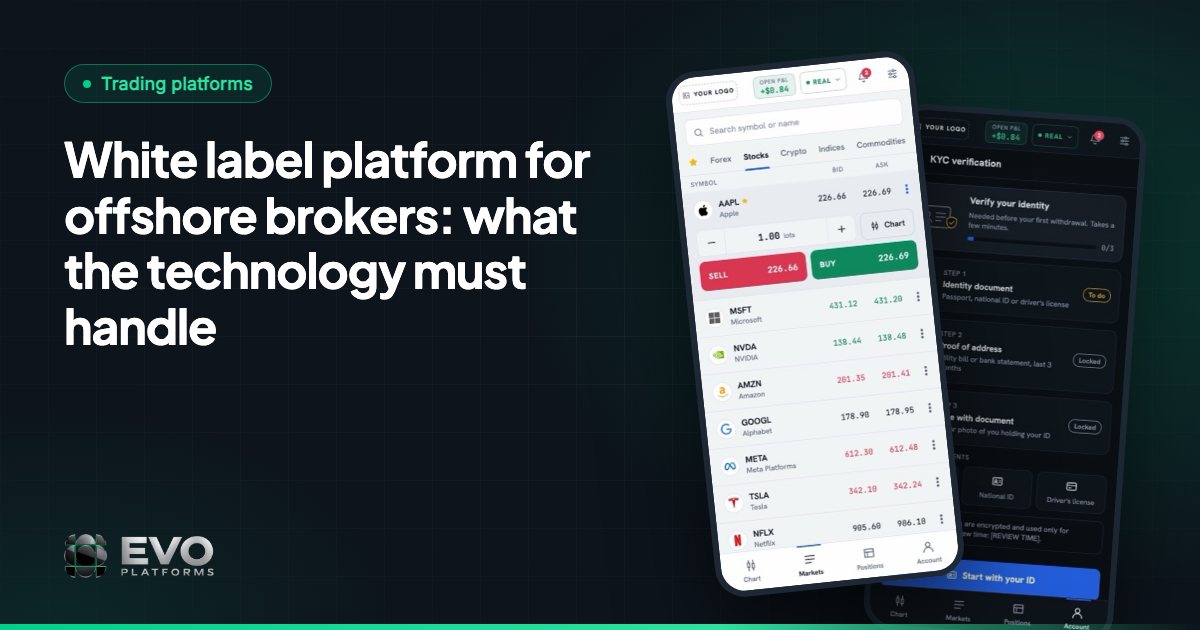
White label platform for offshore brokers: what the technology must handle
The technology an offshore broker needs from a white label platform: launch speed, payments, languages, B-book risk tools, security for remote teams, 24/7 support and pricing, with the questions to ask about each.
 EVO PlatformsTrading platforms8 min read
Your first client deposits in USDT from Lagos at 2 a.m. Your second wants a bank transfer in Peru. Your sales desk works in English, Spanish and Arabic, and your marketing budget starts burning the day the campaign goes live, whether the platform is ready or not.
That is a normal day for an offshore broker: a brokerage that serves clients across many countries instead of one home market. This guide covers the technology such a broker needs from a white label platform (launch speed, payments, languages, risk tools, security, support and pricing) with the questions to ask about each.
Key takeaways
- Offshore brokers need a platform that launches in days, takes their clients' payment methods, speaks their languages and supports a B-book.
- Payment flexibility means connecting your own provider and handling local methods, not choosing from a fixed list.
- Remote, multi-country teams need an IP whitelist, 2FA, activity logs and a dedicated server.
- A revenue share grows with your revenue; a flat monthly fee keeps platform cost predictable as you scale.
- EVO: live in 24 hours, from $2,500 a month, no setup fee, no revenue share, payable in USDT.
What does an offshore broker need from a white label platform?
In short: a platform that goes live fast, takes the payment methods your clients actually use, speaks their languages, gives your dealers B-book risk controls, keeps a remote team secure and has people answering at any hour. Price matters too, because most offshore brokers start lean.
A white label trading platform gives you a finished trading platform, CRM and back office under your own brand. For an offshore broker, the real test is whether it fits a business with clients in many countries and a team spread across several time zones.
| Need | Why it matters offshore | What to ask the provider |
|---|---|---|
| Speed to launch | Marketing, partner and staff costs start before the first deposit | How many days from signing to the first live client? |
| Payments | Clients pay by crypto, local transfer, e-wallet or card, depending on the country | Can you connect my own payment provider? How are local methods handled? |
| Languages | Clients deposit more readily in their own language | Which languages do the platform, CRM and website support today? |
| Risk tools | Many offshore brokers run a B-book and carry client risk | Can I set spreads per symbol, leverage per client and stop out levels? |
| Security | Agents and managers often work remotely | Is CRM access restricted by IP, with 2FA and activity logs? |
| Support | Clients trade in every time zone | Is support 24/7, and through which channel? |
| Pricing | Margins are thin in the first months | Is there a setup fee or a revenue share? |
How fast can an offshore broker launch on a white label platform?
With the right provider, in days rather than months. A ready platform with CRM, back office and website is branded and configured quickly; a custom build or a stack of separate vendors takes far longer.
Speed matters offshore because so much is already moving: affiliates waiting for links, a sales team on salary, campaigns booked in several countries.
Illustration: a broker spends $20,000 a month on salaries, office and marketing before launch. If setup takes eight weeks instead of one, that is roughly $32,000 spent with no deposits coming in, before counting the clients who signed with a competitor that was ready.
Ask for a step-by-step timeline and a list of what you must supply: logo, colours, domain, the symbols you want to offer and your payment details. A provider that can't list the steps probably hasn't done it often.
On EVO, brokers go live in 24 hours. Here is how a 24-hour broker launch works.
Which payment methods should an offshore broker's platform support?
The ones your clients use in each country, which is rarely just one. Crypto such as USDT, local bank transfers, e-wallets and cards all show up, and the mix changes from one market to the next.
Ask the provider:
- Can my own payment provider be connected to the platform, and who builds that integration?
- Can methods without an integration be handled manually, with my finance team crediting the deposit?
- Does every deposit and withdrawal show in the CRM against the right client?
- How long does a new payment integration take?
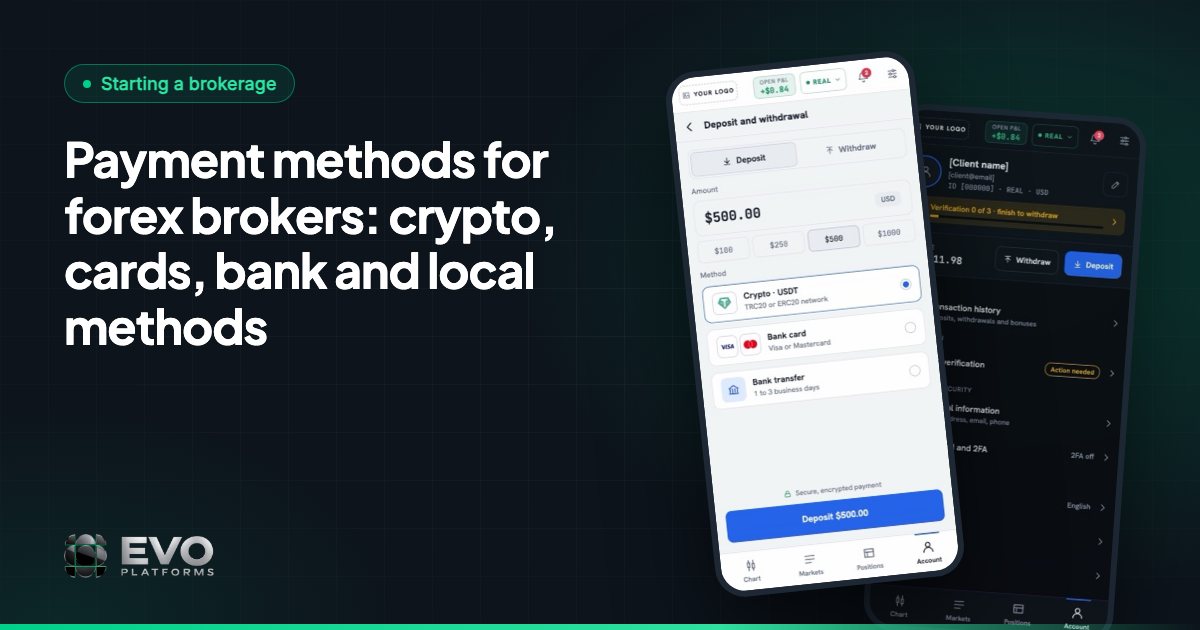
A failed deposit is the most expensive moment in a broker's funnel, because the client has already decided to fund. Our guide to forex broker payment methods covers the options and their trade-offs.
EVO connects the broker's own payment method through a custom integration, and local methods can be handled manually by your team, so you are not limited to a fixed list of gateways. Need a specific provider connected? EVO builds custom features on request.
How many languages does an offshore broker's platform need?
As many as your target markets, and they need to cover the client-facing WebTrader and website, not only the marketing pages. A client who registers in Spanish and then lands on an English-only trading screen is a client your retention desk will struggle to keep.
| Target market (illustration) | Languages to plan for |
|---|---|
| Latin America | Spanish, Portuguese |
| West and North Africa | French, English, Arabic |
| Middle East | Arabic, English |
| CIS | Russian |
| Clients in Europe | German, Spanish, English |
| Southeast Asia | Vietnamese, Thai, Indonesian |
Check three layers: the trading platform, the client-facing website and the CRM your agents use.
EVO runs in English, Arabic, German and Spanish, and other languages are added on request. See EVO's language support for details.
Planning to launch in several countries at once? Message us on Telegram and we'll walk you through languages, payments and timelines for your markets.
Talk to us on TelegramWhat risk tools does an offshore B-book broker need?
Controls you can change per symbol and per client, plus a live view of exposure. Many offshore brokers run a B-book, taking the other side of client trades instead of passing them to the market, so the platform has to let the dealing team manage that risk directly.
- Spreads per symbol, so you can price each instrument for its liquidity and your margin.
- Leverage per client, so a new or high-risk account gets lower leverage than a proven one.
- Symbol limits, to cap exposure on a single instrument.
- Margin call and stop out levels, applied automatically.
- Suspended or disabled accounts, to stop abuse fast.
- A dealing room, where your dealers watch open positions and exposure in one place.
Price data matters as well. Using the provider's feed is fastest; plugging in your own gives you more control. Read why your own price feed matters and our guide to B-book risk management.
EVO was built for B-book brokers: it includes a dealing room for B-book brokers, the controls above and its own real-time price feed with 250+ symbols, or you can plug in your own feed. Risk groups are coming soon.
How should the platform protect a remote, multi-country team?
By controlling who gets into the CRM, from where, and logging what they do. Remote teams widen the door to data theft, and the usual culprit is an insider, such as a departing agent copying the client list.
- IP whitelist, so the CRM opens only from approved addresses.
- OTP / 2FA, so a stolen password alone is not enough.
- Activity logs, so you can see who exported, edited or viewed what.
- Roles, so each agent sees only the leads and clients they work on.
- A dedicated server, so your data doesn't share a machine with other brokers.
- Backups, so a hardware failure doesn't cost you your client records.
Ask where backups are stored and how often they run. There is more in our guide to forex broker security.
Every EVO broker gets its own dedicated server, with servers and databases backed up on AWS. CRM access is protected by an IP whitelist, OTP/2FA and activity logs, and roles control what each team member can see.
What support should an offshore broker expect from a provider?
Round-the-clock support with a direct line to people who know your setup. Your clients trade through the London, New York and Asian sessions, and if a server issue hits at 3 a.m. your time, a ticket answered next business day is too late.
- Is support available 24/7, weekends included?
- Is there a direct channel, such as a dedicated group, or only a ticket form?
- Is the server monitored around the clock?
- Who handles configuration requests, like a new symbol or a spread change?
EVO gives each broker a dedicated Telegram group with 24/7 support, plus 24/7 server support and uptime monitoring. Our article on customer support for forex brokers covers your side of the support job.
How much does a white label platform cost an offshore broker?
Expect one of three models: a setup fee plus a monthly fee, a revenue share, or a flat monthly subscription. One market guide puts MT5 white label setup fees at about $5,000 to $15,000 one-time plus $1,000 to $5,000 a month (B2Broker, as of November 2026 — check their site). An operator guide lists $5,000 to $20,000 setup and $2,000 to $7,000 a month as planning ranges for a white label route (Track360, as of November 2026 — check their site).
A revenue share looks cheap at the start but grows with every dollar you earn.
| Model (illustration) | Year-one platform cost | What happens as you grow |
|---|---|---|
| Setup + monthly: $10,000 setup + $3,000/month | $46,000 | Fixed, though add-ons may cost extra |
| Revenue share: 20% of $40,000 monthly revenue | $96,000 | Rises with every extra dollar you earn |
| Flat monthly: EVO at $2,500/month, no setup fee | $30,000 | Fixed, with no share of your revenue |
EVO plans start at $2,500 per month with no setup fee and no revenue share, and the subscription can be paid in USDT, which suits offshore brokers who keep part of their treasury in stablecoins. Read EVO pricing explained and the full cost to start a brokerage, or compare plans on the EVO pricing page.
What should be on an offshore broker's platform checklist?
Eight checks cover most of it. Get every answer in writing before you sign.
- 1A launch timeline in days, with the list of what you must supply.
- 2Your own payment provider connected, and a clear process for local methods.
- 3The languages your markets need, on the platform, website and CRM.
- 4Spreads per symbol, leverage per client, symbol limits and stop out.
- 5A dealing room if you run a B-book.
- 6IP whitelist, 2FA, activity logs and a dedicated server.
- 724/7 support through a direct channel.
- 8A total year-one cost, with any revenue share spelled out.
Switching later is possible but costly. If your current platform fails these checks, read how to switch trading platform provider. To see the full EVO package, visit the EVO white label solution page.
Frequently asked questions
What does offshore broker mean in this guide?
A brokerage that serves clients across many countries instead of one home market. This guide covers only the technology such a broker needs.
How quickly can an offshore broker go live on a white label platform?
It depends on the provider. Some take weeks or months; EVO brokers go live in 24 hours.
Can my clients deposit in USDT?
That depends on the payment provider you use. EVO can connect your own payment method through a custom integration, and local methods can be handled manually.
Is a revenue share cheaper than a monthly fee?
Sometimes at very low volume, rarely once you grow. In our illustration, 20% of $40,000 monthly revenue costs $96,000 a year, against $30,000 for a flat $2,500 a month.
Do I need a dedicated server?
It is the safer choice: your data and performance don't depend on other brokers. Every EVO broker gets its own dedicated server.
Can I run more than one brand?
Yes. On EVO you can run more than one brand, each with its own branding.
We build EVO — the white-label trading platform, CRM and back office for brokers — and have worked with brokerages since 2020.
Published: 8 min read
This article is for general information only and is not legal, tax or financial advice.
Go live in 24 hours — talk to us on Telegram
Trading platform, CRM, back office and price feed on your own server, in your brand. Plans start at $2,500 a month, with no setup fee and no revenue share.