Demo accounts: how brokers use them to win real traders
A demo account wins nothing on its own. Here is how brokers turn demo users into funded traders: treat every demo as a lead, keep demo and live conditions aligned, and measure demo to live conversion.
 EVO PlatformsCRM7 min read
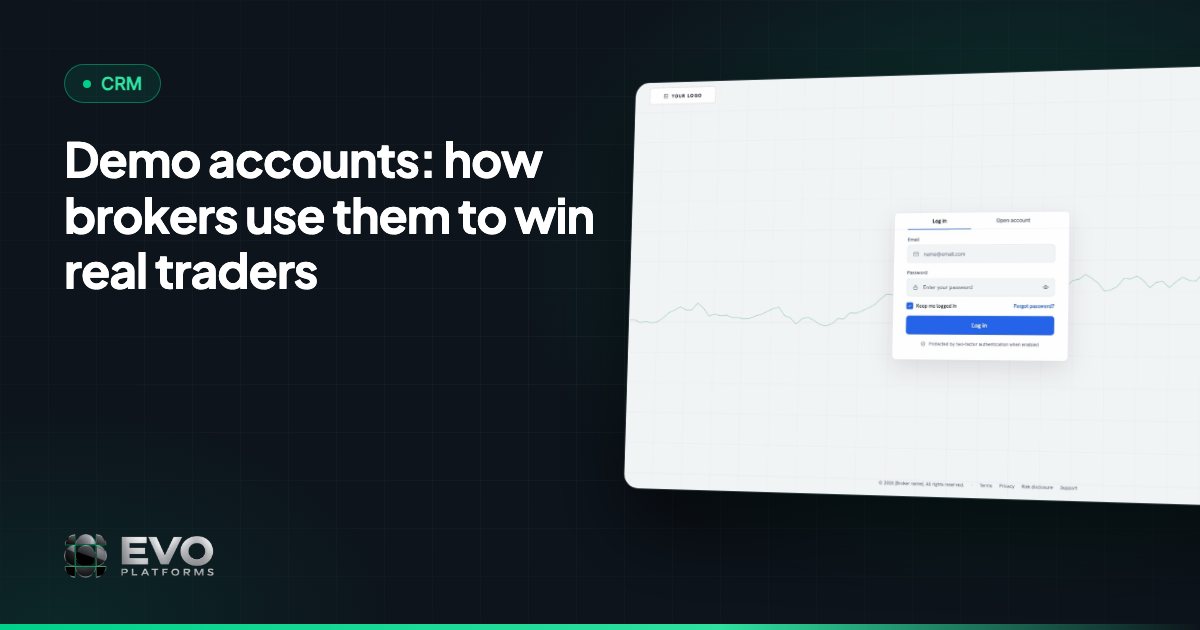
A forex demo account lets a prospective client practise on your platform with virtual funds before trading for real, and brokers use it to turn curious visitors into funded traders. The demo itself wins nothing: what wins is how you treat the person behind it, with a fast and helpful first contact, a demo that behaves like the live account and a clear, low-pressure path to going live.
This guide covers who opens demo accounts, how to work them as leads, the signs that a demo trader is ready for a live account and how to measure demo to live conversion. It describes general brokerage practice, so it applies whatever trading platform you run.
Key takeaways
- A demo account is the first step of the client journey, not a separate audience.
- Treat every demo sign-up as a lead with a source, a status, an owner and notes.
- Keep demo and live conditions aligned: same symbols, spreads, prices and margin rules.
- Open with help, watch for signs of readiness, then guide verification and the first deposit.
- Measure demo to live conversion by source and agent, and keep demo numbers separate from live.
What a demo account is really for
For the trader, a demo is a test drive. They learn the platform, check spreads and how orders behave, and try an idea without consequences. For the broker, a demo is a signal of intent. Someone who opens a demo and places practice trades is much warmer than someone who only read a landing page.
That is why a demo should never be treated as a separate audience or a product in its own right. It is the first step of the client journey. Brokers who leave demo users alone in a sandbox usually watch them drift away, often to a competitor who called first.
Demo users also come in different types, and each needs a different conversation:
- Beginners who want to learn the basics of orders, margin and charts before they trade.
- Experienced traders testing your conditions: spreads, symbols, speed and the order box.
- Comparison shoppers with demos open at several brokers, deciding where to go live.
Recording which type you are talking to, in a CRM status or a comment, helps every later call start in the right place.
Treat every demo sign-up as a lead
Whatever tool runs the demo, the person behind it belongs in your CRM as a lead, with a source, a status, an owner and notes, exactly like any other sign-up. Our guide to lead generation for forex brokers covers the full path from sign-up to first deposit; for demo users, these habits matter most:
- Record the source: which campaign, page or referral brought them.
- Assign an owner quickly, so one named person is responsible for the follow-up.
- Use clear statuses, for example “demo opened”, “trading on demo”, “asked about live” and “live account opened”.
- Add a comment after every call, so the next agent never starts from zero.
Make the demo feel like the live account
The quickest way to lose a trader’s trust is a demo that behaves differently from live. If someone sees tight spreads on demo and wider ones after they deposit, or finds symbols on demo that are missing on live, they feel misled, and they tell other traders.
- Same symbols and the same spreads as your live conditions.
- Same prices: a real-time stream with no delays, so charts match what live clients see.
- Same platform and client area, so going live feels like the next step, not a new product.
- Same margin rules, including margin call and stop-out levels.
A simple example: a trader opens 1 lot of EURUSD on demo and watches their free margin move as the price moves 20 pips. If their live account will use different leverage, explain it before they deposit, not after. Our explainers on margin call and stop out and on why your own price feed matters go deeper.
When that trader goes live on EVO WebTrader, the conditions are yours to control: spreads are set per symbol, leverage is set per client, and the price feed streams 250+ symbols in real time, with any symbol added on request.
The first contact: help, don’t pitch
Call new demo users while the platform is still open in their browser, ideally the same day. A demo user who hears nothing for a week has usually moved on.
Open with help, not a deposit request. A short, practical call builds more trust than any script about bonuses or opportunities:
- 1Confirm they could log in and that the platform works on their device.
- 2Ask what they want to trade and why: forex, metals, indices, crypto or stocks.
- 3Show one useful thing, such as setting Take Profit and Stop Loss or building a watchlist.
- 4Agree a next step and a date for the follow-up call.
- 5Write it all in the CRM before moving to the next lead.
Language matters too. In Arabic-speaking markets, offer the call in Arabic and a platform that reads properly right to left. EVO WebTrader is available in English, Arabic with full RTL, German and Spanish, with more languages on request.
Want to see demo and live accounts running on your own brand? We can have you live in 24 hours.
Talk to us on TelegramSigns a demo trader is ready to go live
Good agents watch for moments when the conversation is ready to move from learning to practicalities:
- They trade on demo regularly over several days.
- They ask how deposits and withdrawals work, or which payment methods you accept.
- They ask what verification involves.
- They compare your spreads or symbols with another broker.
- They come back to the demo after a break.
At that point, help them with the three practical steps: opening the live account, verifying, and making the first deposit. Our guide to KYC verification for brokers covers a smooth onboarding flow, and our article on payment methods for forex brokers explains why offering USDT and other crypto, cards, bank transfer and local methods makes the first deposit easier.
Common mistakes with demo accounts
- Leaving demo users to automated emails only. Emails help, but a real conversation converts.
- Pushing for a deposit on the first call. It turns a helpful contact into a sales pitch.
- Demo conditions that look better than live. It wins a deposit once and loses the client after.
- Endless demos with no next step. Agree a check-in date, so practice turns into a decision.
- Mixing demo and live numbers in reports. Your conversion figures will look better than they are.
Be honest about one more thing: demo results do not predict live results. Trading feels different when real funds are at stake, and saying so openly builds the kind of trust that keeps a client after the first deposit.
How to measure demo to live conversion
Demo to live conversion is the share of demo users who open and fund a live account within a period you choose. Track it by source and by agent, not only as one overall number.
| Metric | What it tells you |
|---|---|
| Demo sign-ups by source | Which campaigns bring engaged users, not just clicks |
| Demo users contacted | Whether your desk keeps up with new sign-ups |
| Demo to live account | How well agents turn interest into action |
| Demo to first deposit | Your real conversion, the number that matters |
| Time from demo to first deposit | How long your sales cycle is, and where it stalls |
For a wider set of numbers across marketing, sales and retention, see brokerage KPIs. Once demo users become funded clients, the retention desk takes over.
Running demo leads with EVO
EVO Platforms gives your team EVO CRM, the back office, EVO WebTrader and the price feed in one system. Leads arrive with their source, sales and retention desks work in the same CRM, and every deposit and withdrawal goes through an approval flow.
Every brokerage handles demo accounts a little differently. Tell us how you want yours to work and we will explain what fits your EVO setup. You can be live in less than 24 hours on a dedicated isolated VPS, with 24/7 support on Telegram at @evoplatforms. EVO plans start from $2,500 per month: see pricing or contact us.
Frequently asked questions
What is a forex demo account?
A forex demo account is a practice account where a trader uses virtual funds on a broker’s platform. It lets them learn the platform and test the broker’s conditions before opening a live account.
Why do brokers offer demo accounts?
Because a demo user has shown real intent. A demo lets prospective clients try the platform without risk, and it gives the broker’s sales desk a warm lead to help towards a live account.
How can a broker improve demo to live conversion?
Contact demo users quickly, open with help rather than a deposit request, keep demo and live conditions aligned, watch for signs of readiness and make verification and the first deposit simple.
Should demo conditions match live conditions?
Yes. Symbols, spreads, prices and margin rules on demo should reflect the live account. A demo that looks better than live may win one deposit but usually loses the client’s trust.
Does EVO support demo accounts?
Talk to us about it. Tell us how you want demo accounts to work at your brokerage and we will explain what fits your EVO setup. Message us 24/7 on Telegram at @evoplatforms or use the contact page.
We build EVO — the white-label trading platform, CRM and back office for brokers — and have worked with brokerages since 2020.
Published: Updated: 7 min read
This article is for general information only and is not legal, tax or financial advice.
Go live in 24 hours — talk to us on Telegram
Trading platform, CRM, back office and price feed on your own server, in your brand. Plans start at $2,500 a month, with no setup fee and no revenue share.