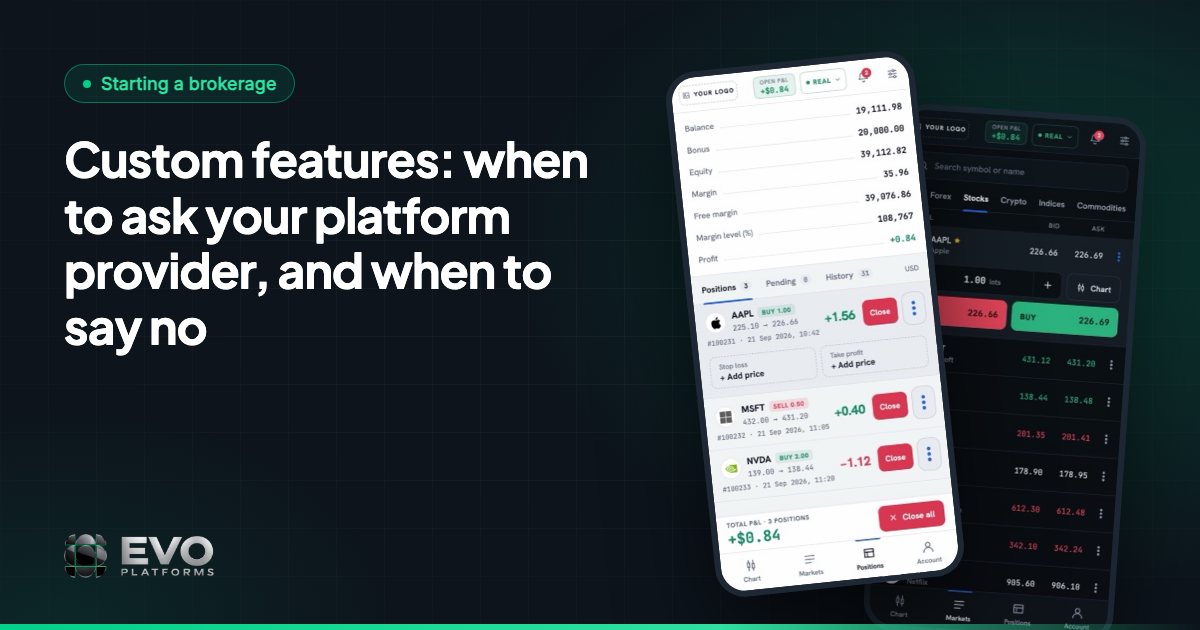
Custom features: when to ask your platform provider, and when to say no
Some feature requests are a two-minute setting, some add real deposits and some never pay back. Here is how brokers decide when to ask their platform provider for custom work, how to brief it and what to agree before anyone writes code.
 EVO PlatformsStarting a brokerage8 min read
Your head of retention wants a new lead status. Finance wants the local payment method clients keep asking about. Your dealer wants an alert when one client's exposure gets too big. One of these is a two-minute settings change, one could add thousands to monthly deposits, and one might cost more than it ever earns.
This guide gives you a simple way to tell them apart: what counts as a custom feature, when it is worth asking your provider, how to check whether it will pay for itself, and how to write a request your provider can actually build.
Key takeaways
- First check whether a request is configuration, provider setup or real development; many are configuration you can do yourself.
- Ask for custom work when it moves deposits, FTDs or retention, is used often and has no workaround.
- Be strict: research suggests about half of software features are hardly ever or never used.
- Write requests as business problems with frequency, money at stake and an example, then agree scope, cost, timing and maintenance in writing.
- Providers that own their code and give each broker a dedicated server can build what shared or third-party platforms usually cannot.
What counts as a custom feature?
A custom feature is something your platform cannot do today, even with every setting changed. Before you ask for development, check which of three levels your request sits on:
| Level | Examples | Who does it | Typical effort |
|---|---|---|---|
| Configuration | New lead status, spreads per symbol, leverage per client, a new user role | Your own team, in the CRM or admin | Minutes |
| Provider setup | Branding, website pages, an extra language, a second brand | The provider, as part of the service | Usually days |
| Custom development | A new payment integration, a new report, a new workflow or screen | The provider's developers | Days to weeks, depending on scope |
Many requests that land on a provider's desk turn out to be configuration. Knowing what your platform already does saves time and money, so run through a checklist such as our overview of forex CRM features first.
A lot of what brokers ask for is already configuration in EVO. You add custom lead statuses from inside the CRM, set up desks and roles for large teams, run reports and an affiliate system, and set spreads per symbol, symbol limits and leverage per client. The WebTrader comes in your colours with light and dark themes, in English, Arabic, German and Spanish, with any other language on request. See EVO CRM.
When should you ask your provider for a custom feature?
Ask when the feature touches money directly, or when your team repeats a manual task every day. Four questions settle most cases:
- 1Does it move deposits, FTDs or retention? A local payment method your clients actually use passes this test easily.
- 2How often will it be used? A step your sales desk repeats 200 times a day beats a report someone opens once a quarter.
- 3Is there really no workaround? If a setting, a report export or a change in routine solves it, use that first.
- 4Does it fit your market? A language your clients speak, or a payment flow local banks expect, can decide whether a lead becomes a funded client.
If you answer yes to the first two and to at least one of the others, the request is worth raising. Payments are the classic case: our guide to forex broker payment methods shows how much deposit conversion depends on offering the methods clients already trust.
How do you know if a custom feature will pay for itself?
Put a rough number on the gain, compare it with the cost and the wait, and be strict. The Standish Group's 2013 CHAOS research found that only about 20% of software features are used often, while about 50% are hardly ever or never used. A brokerage's wish list is no different.
Illustration: a broker with 150 FTDs a month notices that about 40 clients a month from one country start a deposit and give up because their international cards are declined. If a local payment method converts a third of them, that is about 13 extra FTDs a month. At an illustrative $300 average first deposit, that is roughly $3,900 a month in new deposits, before a single redeposit.
| Request | Money impact | How often used | Verdict |
|---|---|---|---|
| Local payment method for your main market | High: more FTDs and redeposits | Every deposit | Ask now |
| A report managers check every morning | Medium: faster decisions | Daily | Ask, if no export covers it |
| A new lead status for a campaign | Medium | Daily | Do it yourself in the CRM |
| A bespoke screen one VIP trader asked for | Low | One client | Skip |
| A copy of a competitor's feature list | Unknown | Unknown | Wait until clients ask |
When should you not ask for a custom feature?
Skip it when it solves a rare problem, copies a competitor without evidence, or delays your launch. These are the common traps:
- Customising before launch. New brokers often want a perfect platform before their first client. Launch, collect real data, then customise. See how launching a broker in 24 hours works on a standard setup.
- Building for one person. A feature that one trader or one agent wants rarely pays back.
- Fixing a process problem with code. If leads go cold because nobody follows up, a new button will not help. Fix the desk routine first; our guide to forex CRM lead management shows how.
- Copying feature lists. A competitor's marketing page is not proof that their clients use those features.
- Anything nobody will maintain. Every custom feature has to keep working after each platform update. Ask who looks after it.
Several of these show up in our list of mistakes new brokerages make.
Have a feature in mind? Send it to us on Telegram and we will tell you honestly whether it is a setting, a build or something to skip.
Talk to us on TelegramHow do you write a feature request your provider can build?
Describe the business problem, not the screen you imagine. Developers build faster and better when they know why. A good request covers seven points:
- 1The problem: what is missing or going wrong today.
- 2Who uses it: dealers, sales agents, finance or clients.
- 3How often: daily, weekly, on every deposit.
- 4The money at stake: your rough estimate of deposits, FTDs or staff hours.
- 5What done looks like: how you will know it works.
- 6An example: a screenshot, a sample report or a step-by-step flow.
- 7Priority and deadline: and whether a simpler first version would do.
Illustration: “Add a report” is hard to build. “Our head of retention needs a daily list of funded clients who have not traded for 7 days, split by desk, so she can assign calls each morning” can be scoped in one conversation.
What should you agree before custom work starts?
Agree scope, cost, timing and ownership in writing before anyone writes code. These questions head off most disputes:
| Question | Why it matters |
|---|---|
| What exactly is in scope? | Stops a small job growing into a large invoice |
| Fixed price, hourly or included? | Lets you compare the cost with the gain you estimated |
| When will it be delivered and tested? | You can plan campaigns or desk changes around it |
| Who maintains it after updates? | A feature that breaks after each update is a liability |
| Will it become part of the standard product? | Your request may help other brokers too, which can change the cost |
| Can you keep your data if you leave? | Protects you if you ever change provider |
Custom work is often what makes a later move hardest. Our guide to switching trading platform providers explains how to plan for that from day one.
Why does your provider's setup decide what is possible?
A provider can only build for you if it owns its code and runs your brokerage on its own server. When a platform is rented from a third-party vendor, or many brokers share one installation, changes to the core are usually out of reach, because one change would affect everyone.
- Own code: the provider can change the product itself, not only the settings around it.
- A dedicated server per broker: your custom feature runs on your instance without touching anyone else's.
- Developers close to support: the people who hear your request sit near the people who build it.
This is also a key difference between renting a white label and building your own platform; see white label vs building your own trading platform.
At EVO, everything is built in-house to high code-quality standards, and custom features are built on request. Each broker runs on its own dedicated server, so a feature built for you stays yours. Payments are a common example: EVO can build a custom integration of your own payment method, or local methods can be handled manually while you grow. Talk to us on Telegram about the scope and cost of the feature you need.
Plans start at $2,500 per month with no setup fee and no revenue share; see our white label page for what comes as standard.
Frequently asked questions
Will my provider charge for custom features?
It depends on the provider and the size of the job. Ask for the price model in writing, fixed, hourly or included, before work starts.
How long does a custom feature take?
Configuration takes minutes, small changes days, and new integrations or workflows longer. Ask for a delivery date and a test window.
Should I customise my platform before launch?
Usually not. Launch on the standard product, learn what your clients and team actually need, then invest in the features that move deposits.
Can a provider add my local payment method?
Often, if it owns its code. At EVO, EVO can build a custom integration of your own payment method, or local methods can be handled manually.
Does EVO build custom features?
Yes. EVO's in-house team builds custom features on request, on each broker's own dedicated server.
We build EVO — the white-label trading platform, CRM and back office for brokers — and have worked with brokerages since 2020.
Published: 8 min read
This article is for general information only and is not legal, tax or financial advice.
Go live in 24 hours — talk to us on Telegram
Trading platform, CRM, back office and price feed on your own server, in your brand. Plans start at $2,500 a month, with no setup fee and no revenue share.