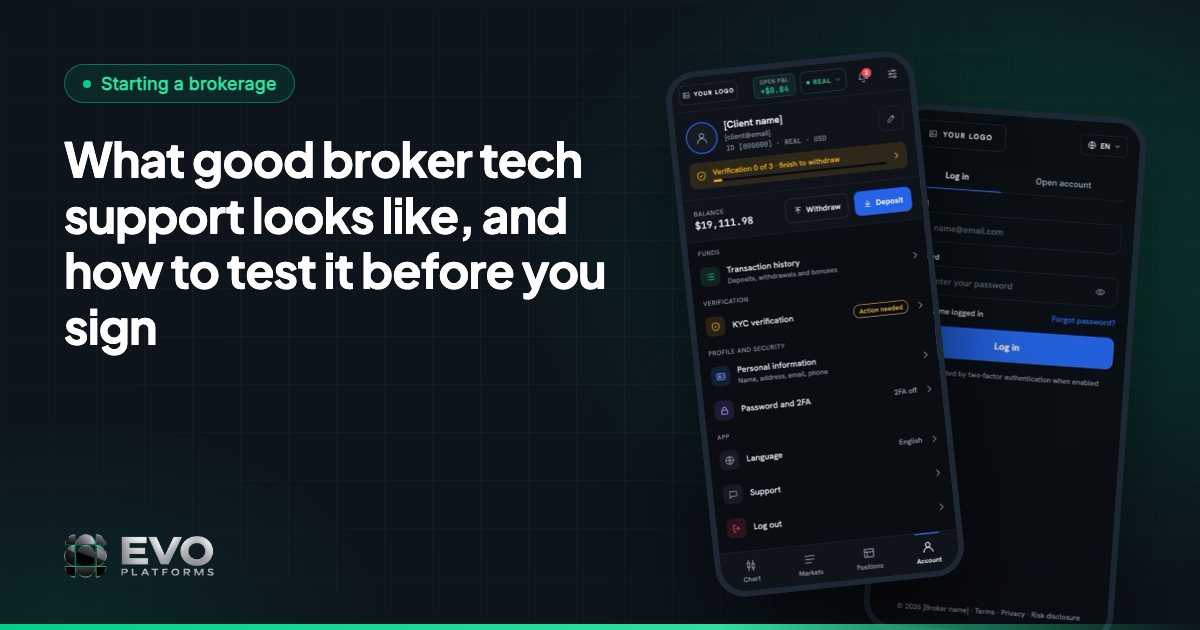
What good broker tech support looks like, and how to test it before you sign
The platform is only half of what you buy from a white label provider. The other half is the people who answer when it breaks. Here is what good broker tech support looks like, what bad support costs and how to test it before you sign.
 EVO PlatformsStarting a brokerage8 min read
It is Sunday evening, the forex market has just opened, and your clients' WebTrader still shows Friday's closing prices. Your dealer messages the provider and gets an auto-reply: tickets are answered within one business day. By Monday morning, three of your best traders have asked to withdraw.
The platform is only half of what you buy from a white label provider. The other half is the people who pick up when it breaks. This guide shows what good broker tech support looks like, how to put a price on bad support, and how to test a provider before you sign.
Key takeaways
- Provider tech support sits underneath your own client support: your desk can only answer traders as fast as your provider answers you.
- Good support means 24/7 coverage, a direct channel to engineers, round-the-clock monitoring, clear priorities and written follow-ups.
- Agree a priority scale in broker terms: anything that stops trading or money movement is critical, at any hour.
- Test support during the sales process: message at odd hours, ask who answers and ask about the last serious incident.
- EVO provides 24/7 support in a dedicated Telegram group per broker, plus 24/7 server support and uptime monitoring.
What is broker tech support, and how is it different from client support?
Broker tech support is the help your provider gives your team: the platform, the CRM, the servers, the price feed and the integrations behind them. Client support is what your team gives your traders. One feeds the other: your agents can only answer clients as fast as your provider answers them.
That makes provider support a link in your own service chain. If a client asks why a deposit has not reached their trading account and the cause sits in the platform, your support desk is stuck until the provider responds. Our guide to customer support for forex brokers covers the client-facing side. This article covers the layer underneath it.
Inside a brokerage, almost every team leans on provider support at some point:
- Dealers and risk managers: prices, symbols, spreads, margin call and stop out behaviour.
- Heads of sales and retention: CRM access, lead statuses, desks and reports.
- Finance: deposits, withdrawals and payment integrations.
- Founders and CEOs: uptime, data, security and anything that touches the brand.
How much does slow tech support cost a broker?
More than most founders budget for, because the real damage is lost trust, not lost hours. Markets run from Sunday evening to Friday night, and the busiest moments, news releases and session opens, are exactly when problems show up.
| What breaks | Short-term cost | Long-term cost |
|---|---|---|
| WebTrader prices freeze during news | Clients cannot open or close trades | Complaints, withdrawals, claims that you play with prices |
| CRM down on a Monday morning | Sales desk cannot call fresh leads | Leads go cold and FTDs drop that week |
| A deposit integration fails | Deposits stuck or rejected | First-time depositors do not come back |
| Stop out does not trigger as set | Unexpected negative balances | Direct losses on the B-book and disputes |
Illustration: a broker earns $60,000 a month in net trading revenue across 22 trading days, roughly $2,700 a day. A problem that takes six hours to fix instead of one eats into that day, but the bigger bill comes later. If that one bad Sunday makes 10 funded clients leave, at an illustrative $500 of net revenue per client per year, the support gap costs about $5,000 a year on top of the outage itself.
That is why support quality belongs in your provider comparison right next to the monthly price.
What does good broker tech support look like?
Good support is reachable at any hour and staffed by people who can actually fix the platform. In practice it shows up as eight habits:
- 124/7 coverage, weekends included. Markets open on Sunday evening, and many incidents happen at night in your time zone. Business-hours support does not fit a trading business.
- 2A direct channel to people, not only a ticket form. You should reach a human who knows your setup without explaining your brokerage from scratch every time.
- 3Engineers who know the code. The fastest fixes come from teams that built the platform, not from a reseller passing tickets to someone else.
- 4Monitoring around the clock. Good providers watch servers and uptime continuously instead of waiting for you to report a problem.
- 5Clear priority levels. A frozen WebTrader and a typo on a report page are different problems and should not wait in the same queue.
- 6Backups and a recovery plan. You should know where backups live and how a restore works.
- 7Plain-language updates during an incident. What happened, who is affected, what is being done and when the next update comes.
- 8A written follow-up afterwards. What caused the problem and what changes so it does not happen again.
Which platform problems should be fixed first?
Anything that stops clients trading or moving money comes first, at any hour. Agree a priority scale with your provider in plain broker language, so nobody argues about urgency at 3 a.m. A simple version looks like this:
| Priority | Broker examples | What to expect from a good provider |
|---|---|---|
| Critical | WebTrader down, prices not updating, CRM unreachable, a data or security incident | Immediate response at any hour, worked until fixed, with updates as it goes |
| High | One symbol's prices stale, margin call or stop out not behaving as set, a deposit integration failing | Fast attention, with a workaround while the full fix is built |
| Normal | A report shows wrong totals, a role cannot see a desk, a translation error | A planned fix with a clear date |
| Request | A new symbol, an extra language, a custom feature | Scoped, priced if needed and scheduled |
If a provider offers response times, get them in writing and ask what happens when they are missed. A promise with no follow-through is only marketing.
Ticket system, email or Telegram group: which support channel works best?
For urgent platform issues, a shared chat group with the provider's team is fastest. Tickets and email suit planned requests. The best setups use both.
| Channel | Strengths | Weaknesses |
|---|---|---|
| Ticket portal | Clear record, easy to track planned work | Slow in emergencies; easy to hide behind auto-replies |
| Familiar, good for documents and approvals | Threads get lost; nobody owns the reply at night | |
| Dedicated chat group (Telegram, WhatsApp) | Fast, both teams in one place, screenshots in seconds | Needs discipline: one issue per message, no passwords in chat |
| Phone | Good for a crisis call | No written record; depends on who answers |
EVO gives every broker 24/7 support in a dedicated Telegram group (@evoplatforms), where your team talks directly to ours. Behind it sit 24/7 server support and 24/7 uptime monitoring, so your platform is watched around the clock, not only when someone raises a ticket.
How do you test a provider's support before you sign?
Treat the sales process as a free trial of their support. How a provider answers you before you pay is the best case of how it will answer after.
- 1Message at an awkward hour. Send a question on a Sunday evening or late at night in your time zone, and note who replies and how.
- 2Ask who actually answers. A reseller, an outsourced help desk or the team that built the platform?
- 3Ask how a critical issue is handled. Who gets alerted, how you are kept informed and who can fix it.
- 4Ask about monitoring. Do they watch your servers and uptime around the clock, or wait for your call?
- 5Ask about backups. Where are they stored, and how does a restore work?
- 6Ask about their last serious incident. A confident provider will tell you what happened and what changed. Dodging the question tells you more than any answer.
- 7Ask how routine requests are handled. Adding a symbol or a language should be routine, not a negotiation.
- 8Ask what happens if you leave. Can you export your client and trading data? Our guide to switching trading platform providers explains why this matters.
Want to see how our support works before you commit? Message us on Telegram at any hour and judge the reply yourself.
Talk to us on TelegramWhat does your own team need to do to get fast support?
Give your provider clean information and clear access rules. Even the best support team is slow when reports are vague.
- Name one or two owners on your side who raise issues and approve changes, so the provider is not taking orders from ten people.
- Report issues in one format: what is wrong, who is affected (all clients, one desk, one symbol), when it started, a screenshot and an account or lead ID.
- Flag the priority on the scale you agreed, and do not mark everything critical.
- Never share passwords in chat. Use the platform's own user roles and invite people properly.
- Keep access tight. IP whitelisting for CRM access, OTP/2FA and activity logs protect you when staff leave. Our forex broker security checklist covers this in detail.
Illustration: compare two messages. “Prices are wrong” gives the provider nothing to start on. “EURUSD on the WebTrader has not updated since 21:05 GMT, all clients, screenshot attached” gives the symbol, the scope and the time in one line, and saves the first half hour of any incident.
Which warning signs suggest support will let you down?
The clearest signs appear during sales: slow replies, vague answers and no named people. Watch for these:
- Support only in business hours, in one time zone.
- Every question goes through a salesperson and never reaches a technical person.
- No clear answer on where backups are kept or how a restore works.
- Urgent support or monitoring sold as an expensive add-on on top of the platform fee.
- Fixes that depend on a third party the provider does not control.
- No written explanation after incidents.
Everything at EVO is built in-house by our own team, so the people answering in your Telegram group work alongside the people who wrote the code. Each broker runs on its own dedicated server, with servers and databases backed up on AWS. Read more in inside EVO's in-house technology, and see what each plan includes on our pricing page.
If you are still comparing providers, our explainer on what a white label trading platform is sets out what the whole deal should include, support being one part of it.
Frequently asked questions
Does a small broker really need 24/7 tech support?
Yes. Markets open on Sunday evening and run through the night in most time zones. A small broker feels one bad night more than a large one, because it has fewer clients to lose.
What is the difference between tech support and an account manager?
Tech support fixes and changes the platform. An account manager handles the commercial side: plans, invoices and renewals. You need both, but at 2 a.m. you need the engineers.
Should I pay extra for premium support?
Compare total cost, not line items. If urgent support or monitoring is an add-on, include it when you compare providers, because you will need it.
Is a Telegram group secure enough for provider support?
For coordination, yes, if your team keeps passwords and full client data out of the chat. Access to the CRM itself should stay protected by IP whitelisting and 2FA.
How does EVO handle support?
Every EVO broker gets 24/7 support in a dedicated Telegram group (@evoplatforms), backed by 24/7 server support and 24/7 uptime monitoring from the in-house team.
We build EVO — the white-label trading platform, CRM and back office for brokers — and have worked with brokerages since 2020.
Published: 8 min read
This article is for general information only and is not legal, tax or financial advice.
Go live in 24 hours — talk to us on Telegram
Trading platform, CRM, back office and price feed on your own server, in your brand. Plans start at $2,500 a month, with no setup fee and no revenue share.