Offering stock CFDs: what brokers should know
How a brokerage adds stock CFDs to its platform: choosing the first stocks, handling exchange hours and gaps, and setting spreads, limits and leverage so shares sit safely next to forex and gold.
 EVO PlatformsStarting a brokerage7 min read
To offer stock CFDs, a broker needs three things: a price feed that streams live share prices, a trading platform where clients can find and trade those stocks, and risk settings built for markets that open, close and gap. Stock CFDs let clients go long or short on a company's share price without owning the share, and they are one of the most effective ways to turn a forex brokerage into a complete multi-asset broker.
This guide covers what stock CFDs are, why brokers add them, which stocks to list first and how to set them up safely, plus how the price feed and EVO WebTrader handle stocks.
Key takeaways
- A stock CFD lets clients trade a share's price, long or short, on margin, without owning the share.
- Stocks help both desks: well-known names give sales a new reason to call and give retention something new for funded clients.
- Start with leading US stocks and the local names your audience asks for, then add symbols on request.
- Stocks follow exchange hours and can gap at the open, so set spreads and limits per symbol and review leverage per client.
- EVO's built-in feed streams 250+ symbols in real time, with a Stocks tab in EVO WebTrader and any symbol added on request.
What is a stock CFD?
A contract for difference (CFD) on a stock is an agreement to exchange the difference in a share's price between the moment a position opens and the moment it closes. The client never owns the share, has no voting rights and never deals with a stock exchange. They simply trade the price movement, up or down, through your platform.
For the client this brings three advantages: they can go short as easily as long, trade on margin instead of paying the full value, and trade stocks from the same account and platform they use for forex and gold. For the bigger picture, see What is a CFD broker?.
| Buying the share | Trading a stock CFD | |
|---|---|---|
| Ownership | The client owns the share | No ownership; the client trades the price |
| Direction | Gains mainly when the price rises | Long or short |
| Capital | The full value of the position | A margin deposit, set by leverage |
| Main risk | The share falls | Leverage magnifies both gains and losses |
Why brokers add stock CFDs
Most retail traders start with forex or gold, but stocks have one big advantage: clients already know the names, from the companies behind their phone to their favourite apps. That familiarity helps your desks and your product:
- Sales: campaigns around well-known companies and earnings season give your sales desk a fresh reason to call leads who did not respond to forex offers.
- Retention: clients who trade one market often want to try another. Stocks give your retention desk something new to offer funded clients, a theme we cover in our client retention guide.
- Product depth: a watchlist with forex, metals, indices, crypto, commodities and stocks looks like a serious multi-asset broker, which helps when clients compare you with larger brands.
Stock CFDs do not replace forex and gold, which usually stay at the centre of a new brokerage. Our guide on which markets a new broker should offer suggests a rollout order, and stocks usually arrive once the core markets are running smoothly.
Which stocks to list first
There are thousands of listed companies, and listing all of them would only bury your clients in symbols nobody trades. Start with a short, deliberate list:
- 1The big US names. US stocks CFDs on the largest technology and consumer companies are what clients search for first, and global news keeps them in view every day.
- 2Stocks your audience knows locally. Gulf traders may want companies from their home exchanges; European traders may want German or French blue chips. Ask your sales desk which names come up on calls.
- 3Stocks that match your marketing. If a campaign is built around earnings season or a sector such as technology, those stocks must be live before it starts.
With EVO you are not limited to a fixed menu. The feed already streams 250+ symbols across markets, and when clients keep asking for a name, it can be added on request.
How stocks differ from forex
Brokers who come from forex sometimes treat a stock CFD as just another symbol. In practice, shares behave differently in three ways your team should plan for.
Trading hours follow the exchange
Forex trades around the clock from Monday to Friday. A stock CFD follows its home exchange, so a US stock is quiet during the Asian morning and comes alive when New York opens. Show trading hours clearly, and make sure support can explain why a stock cannot be traded outside its session.
Gaps at the open
Because a stock does not trade overnight on its exchange, news released after hours, such as company results, can make it open several percent away from the previous close. In a gap, a stop loss is filled at the first available price, which can be worse than the level the client set. Explain this in your client education before clients discover it themselves.
Company news and earnings
A currency pair reacts to economic data. A stock also reacts to company events: quarterly results, management changes and corporate actions such as dividends and stock splits. Decide how your team will treat these events, and check how corporate actions are reflected on your platform before you list a stock. And remember that two stocks can behave very differently, so treat each one as its own instrument.
Risk settings for stock CFDs
Every symbol you switch on needs its own settings. EVO runs execution in-house with built-in risk management, and in the EVO back office, which is part of EVO CRM, the controls work like this:
- Spread per symbol: set and adjust the spread on each stock, separately from your forex pairs and gold.
- Limits per symbol: volume and trading limits for each stock, so no single position grows larger than your team is comfortable with.
- Leverage per client: each client gets the leverage that fits their experience. Clients who mainly trade volatile stocks may be better served with lower leverage.
- Margin call and stop out: at your levels, handled automatically, which matters most on days when a stock gaps at the open.
- Take profit and stop loss on every order, with full control over client positions.
A worked example shows why leverage matters on stocks. At 1:20, the margin is 5% of the position's value. If a stock opens 5% lower after weak results, a long position has lost the equivalent of its entire margin before the client can react. At 1:5 the margin is 20%, so the same gap uses a quarter of it. Our article on margin call and stop out explains how these levels protect the account.
Want to see stock CFDs working on your own brand? We can have you live in 24 hours.
Talk to us on TelegramThe price feed behind your stocks
Stock CFD clients watch prices closely at the open and during company news, and frozen quotes at those moments lead straight to complaints. The quality of the price feed matters as much as the length of the symbol list.
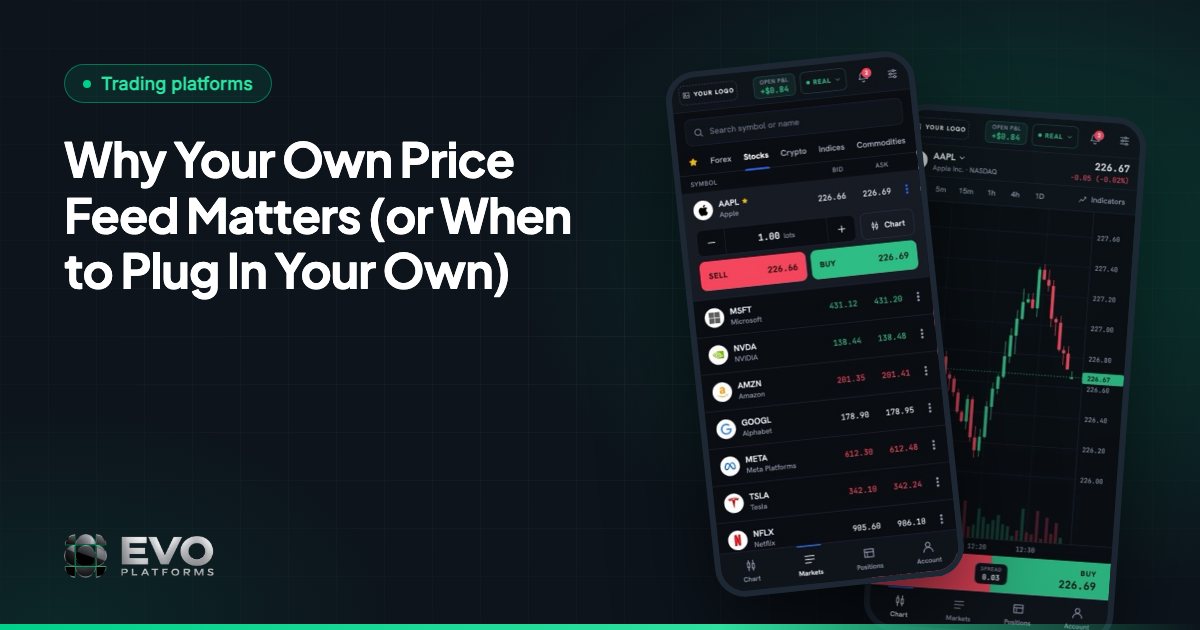
EVO's built-in price feed streams quotes over WebSocket straight to the trading platform in real time, with no delays, across forex, metals, indices, crypto, commodities and stocks. Every market is available as an add-on, and if you already work with your own price provider, you can plug it in instead. For the wider decision, read why your own price feed matters.
What your clients see
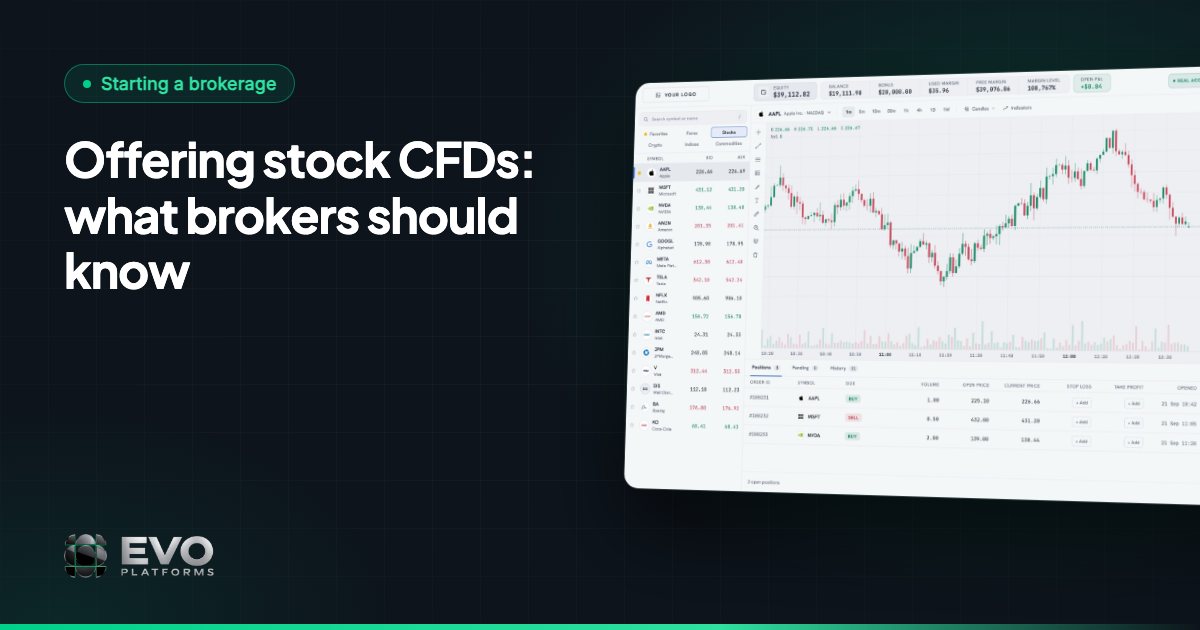
Clients should find a stock in seconds. EVO WebTrader shows a watchlist by category, with a Stocks tab next to Forex, Metals, Indices, Crypto and Commodities. Professional charts, a simple Buy / Sell box with Take Profit and Stop Loss, and a live bar with balance, equity, margin, free margin and P&L sit on one screen, in the browser on desktop and mobile. The platform works in English, Arabic with full right-to-left support, German and Spanish, with more languages on request.
A launch checklist for stock CFDs
- 1Choose a short first list: leading US stocks plus the local names your audience asks for.
- 2Confirm each stock is streaming live in your feed, and request any missing symbols.
- 3Set a spread and volume and trading limits for every stock in the back office.
- 4Review leverage for the clients who will trade stocks, and confirm your margin call and stop-out levels.
- 5Publish trading hours and a short explanation of gaps for clients, and brief your sales and retention desks.
EVO can have your brokerage live in less than 24 hours on a dedicated, isolated VPS, with 24/7 support on Telegram at @evoplatforms. EVO plans start from $2,500 per month: one flat monthly fee, no setup fee and no revenue share. See pricing or contact us to plan your stock list.
Frequently asked questions
What is a stock CFD?
A stock CFD is a contract on the price movement of a company's share. The client can go long or short on margin without owning the share, and trades it on the same platform as forex and gold.
Can a forex broker offer US stocks CFDs?
Yes, as long as its price feed streams the stocks and its platform lets it set spreads, limits and leverage for them. In EVO, stocks are part of the built-in feed and have their own tab in EVO WebTrader.
Why do stock CFDs gap at the open?
A stock trades only during its exchange's session, so news released while the exchange is closed is priced in at the next open.
Can I add a stock that is not in EVO's feed?
Yes. EVO's feed streams 250+ symbols today, and any symbol can be added on request. You can also plug in your own price provider.
How do I control risk on stock CFDs in EVO?
In the EVO back office you set the spread and limits for each stock, give each client their own leverage, and set margin call and stop-out levels that are handled automatically. A dealing room for B-book brokers is available now, and risk groups are coming soon.
We build EVO — the white-label trading platform, CRM and back office for brokers — and have worked with brokerages since 2020.
Published: Updated: 7 min read
This article is for general information only and is not legal, tax or financial advice.
Go live in 24 hours — talk to us on Telegram
Trading platform, CRM, back office and price feed on your own server, in your brand. Plans start at $2,500 a month, with no setup fee and no revenue share.