Best trading platform for B-book brokers: what to look for in 2026
The controls a B-book broker needs from its trading platform — dealing room, spreads per symbol, symbol limits, leverage per client, margin call and stop out — how the main platforms compare, and where EVO fits.
 EVO PlatformsTrading platforms9 min read
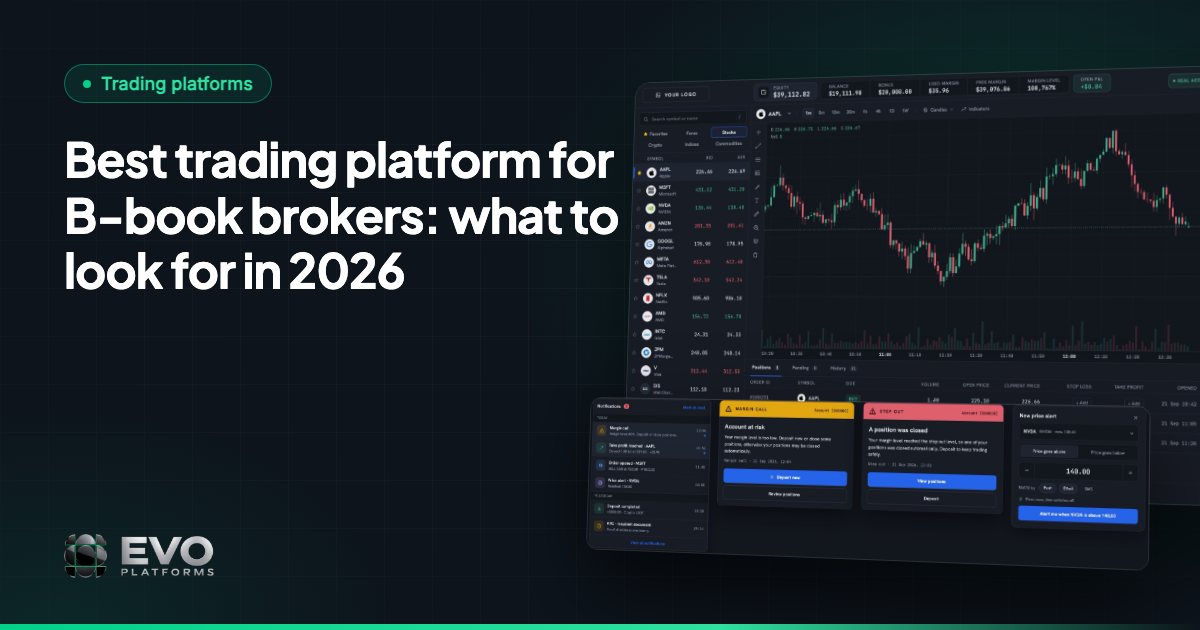
Illustration: it is Friday, US payrolls just came out, and 60 of your clients piled into gold in the same direction. Your platform shows their trades, but not your net exposure, not who is driving it and not a way to tighten limits without calling the vendor. In a B-book, that gap is your money.
This guide sets out what the best trading platform for B-book brokers must do, how the main platforms compare on dealing tools, which pricing model suits a B-book, and where EVO fits, including what it does not do yet.
Key takeaways
- A B-book broker needs to see and control its own exposure: a dealing room, spreads per symbol, symbol limits, leverage per client and automatic margin call and stop out.
- A reliable real-time price feed matters more in a B-book, because slow prices are the easiest profit a trader can take from you.
- MT5 and DXtrade offer deep dealing configuration; all-in-one platforms like EVO trade some depth for launch speed and one bill.
- Percentage fees take a cut of B-book revenue; a flat monthly fee keeps more of it with you.
- EVO is built for B-book brokers, with a dealing room available now; risk groups are coming soon.
What does a B-book broker need from a trading platform?
A B-book broker needs a platform that shows and controls the risk it carries as the counterparty to client trades, live, per symbol and per client. Charts and order types matter to your clients; exposure and controls matter to you.
In a B-book you keep client orders in-house instead of passing them to a liquidity provider, so client profits are your losses and client losses are your revenue. If the model is new to you, start with A-Book vs B-Book vs hybrid.
| Must-have | Why a B-book broker needs it |
|---|---|
| Dealing room | A live workspace where dealers watch exposure and act during the trading day |
| Spreads per symbol | Price each instrument for its own volatility instead of one spread for everything |
| Symbol limits | Cap order size on risky instruments such as gold, indices and crypto |
| Leverage per client | Give new or high-risk clients lower leverage without changing everyone |
| Margin call and stop out | Close losing positions automatically before accounts go negative |
| Suspend or disable accounts | Stop trading on an account in seconds when something looks wrong |
| Reliable real-time price feed | Every exposure figure, P&L number and stop out depends on it |
| CRM on the same client record | Dealers and account managers see the same client |
| Roles, activity logs and access control | Only the right people change risk settings, and every change is recorded |
Why does a B-book broker need a dealing room?
Because exposure changes by the minute and someone has to watch it and act. A dealing room gives your dealers one place for open positions and the controls to respond, instead of piecing the picture together from reports and chat messages.
Day to day, the dealing desk at a B-book broker usually handles:
- Net exposure across symbols, so the desk knows where the book is heavy.
- Unusual activity, such as a sudden jump in trade size or a change in behaviour on one account.
- Fast-market changes to spreads, symbol limits and leverage.
- Accounts that need attention, from margin pressure to accounts that should be suspended.
Ask every vendor to show the dealing view live in a demo, with open positions on it, not a slide. More on the role itself in what is a dealing room.
Which risk controls should be set per symbol and per client?
Spreads and limits belong at symbol level; leverage belongs at client level. That split lets you price each market for its risk and treat each trader according to how they trade.
Illustration: the same 10-lot client position carries very different risk on different symbols, using standard contract sizes.
| Symbol | Net client position | Price move | Swing in broker P&L |
|---|---|---|---|
| EUR/USD | 10 lots long | 50 pips | $5,000 |
| XAU/USD | 10 lots long | $20 | $20,000 |
That is why gold usually gets a wider spread and a lower symbol limit than EUR/USD. Leverage works per client: a new account starts at a moderate default, and a proven account moves to the level your policy allows. Our guide to leverage settings for brokers covers how to set that policy.
Margin call and stop out
Margin call warns a client when margin runs low; stop out closes positions automatically at the level you set. Illustration: a client with $1,000 equity and $500 used margin has a 200% margin level. With a 100% margin call and a 50% stop out, the client is warned at $500 equity and positions start closing at $250. More worked examples are in margin call and stop out explained.
Why does the price feed matter more in a B-book?
Because every client profit comes out of your book, and a slow or wrong price is the easiest profit a trader can take from you. Latency arbitrage, trading on the delay between your feed and faster external prices, targets exactly that gap.
Questions to ask about any platform's feed:
- How many symbols does it cover, and is it real-time?
- Does the provider run the feed itself, or resell a third party's?
- Can you plug in your own feed later?
- Do your dealers see the same prices your clients trade on?
Read why your own price feed matters for the full argument.
How do the main platforms compare for B-book brokers?
MetaTrader 5 and DXtrade offer the deepest dealing configuration, while all-in-one platforms such as EVO trade some of that depth for a faster launch and one bill. Here is what each vendor describes for broker-side controls (as of November 2026 — check their site):
| Platform | B-book controls the vendor describes | Good fit for | Watch out for |
|---|---|---|---|
| MetaTrader 5 | Role-based managers including dealers and risk managers; multi-dealer operation for different client groups; automatic monitoring of margin and other risks; a Manager API for custom tools | Established brokers with a dealing team and clients who ask for MT5 | Setup is a bigger project; extra dealing tools are often bought as third-party plugins |
| DXtrade | Limits on trade size and exposure, and markup profiles, at instrument, group and account level; real-time A/B-book exposure monitoring | Multi-asset brokers that want deep configuration and a hybrid option | Ask whether a CRM and website are included or need other vendors |
| EVO Platforms | Dealing room; spreads per symbol, symbol limits, leverage per client, margin call/stop out, suspended and disabled accounts; own price feed | New and existing B-book brokers who want platform, CRM and website from one provider | Risk groups coming soon; browser-only, no mobile app; no A-book routing |
cTrader, Match-Trader and TradeLocker are also widely used. Compare their broker tools with ours in EVO vs cTrader, EVO vs Match-Trader and EVO vs TradeLocker. If MetaTrader is on your list, see MT5 white label vs EVO.
Want to see a dealing room and risk controls with live positions on screen? Book a demo with EVO and we will walk your dealing team through them.
Talk to us on TelegramWhich pricing model suits a B-book broker?
A flat monthly fee usually suits a B-book broker best, because your revenue comes from client trading and any percentage fee takes a cut of exactly that. Watch for revenue shares, net-deposit fees and fees per million traded.
Percentage models are real: in a December 2021 article, Match-Trade Technologies described net-deposit fees of “usually around 7%” and linked that model to B-book brokers (as of November 2026 — check their site).
Illustration: a B-book broker with 150 FTDs (first-time deposits) a month and $180,000 in net deposits would pay $12,600 a month under a 7% net-deposit fee, about five times a flat $2,500 subscription.
Platform fees are one line in a bigger budget; our guide to the cost to start a brokerage covers the rest.
Is EVO a good trading platform for B-book brokers?
Yes, if you run a B-book and want everything from one provider: EVO is built for B-book brokers, and its dealing room is available now. It is not the right choice if you need A-book routing to liquidity providers or a mobile app.
In EVO, the dealing room works alongside the controls in the back office: spreads per symbol, symbol limits, leverage per client, margin call and stop out, and suspended or disabled accounts. Prices come from EVO's own real-time price feed of 250+ symbols, or you plug in your own. Each broker runs on its own dedicated server with 24/7 server support and 24/7 uptime monitoring, and staff access is protected by an IP whitelist, activity logs and OTP/2FA.
Honest limits to weigh:
- Risk groups are coming soon. Today you manage risk per symbol and per client; group-based conditions are not available yet.
- Browser-only. Clients trade in EVO WebTrader on desktop or phone; there is no mobile app, and MT5 Expert Advisors do not run on it.
- B-book focus. A-book, STP and hybrid routing are not EVO features.
Plans start at $2,500 per month with no setup fee and no revenue share, payable in USDT, and you can go live in 24 hours. See how the dealing room for B-book brokers works in EVO.
What should you test in a B-book platform demo?
Test the controls you will need on a bad day, not the charts. Ask the vendor to do each of these live:
- 1Show net exposure per symbol with open positions on screen.
- 2Change the spread on one symbol and show the result on the client side.
- 3Set a symbol limit on gold and place an order above it.
- 4Change leverage for one client only.
- 5Trigger a margin call and a stop out on a demo account.
- 6Suspend an account and show what the client sees.
- 7Open the activity log entry for each change above.
Then build your daily routine around those controls. Our B-book risk management guide covers that routine, and forex broker security covers who should be allowed to change risk settings.
Frequently asked questions
What is the best trading platform for B-book brokers?
The one that gives your dealers live exposure plus per-symbol and per-client controls at a cost you can carry. MT5 and DXtrade suit large dealing teams; EVO suits brokers who want a B-book setup, CRM and website from one provider.
Do small B-book brokers need a dealing room?
Yes, once real clients trade. Even a small brokerage needs one named person watching exposure and acting on it during market hours.
Can I run a hybrid model on EVO?
EVO is built for B-book brokers; A-book, STP and hybrid routing are not EVO features. If you need routing, talk to us about your setup before you sign.
Does EVO have risk groups?
Risk groups are coming soon. Today EVO controls risk with spreads per symbol, symbol limits, leverage per client, margin call and stop out, and suspended or disabled accounts.
How fast can a B-book broker go live on EVO?
In 24 hours, on its own dedicated server, from $2,500 per month with no setup fee and no revenue share.
We build EVO — the white-label trading platform, CRM and back office for brokers — and have worked with brokerages since 2020.
Published: 9 min read
This article is for general information only and is not legal, tax or financial advice.
Go live in 24 hours — talk to us on Telegram
Trading platform, CRM, back office and price feed on your own server, in your brand. Plans start at $2,500 a month, with no setup fee and no revenue share.