All-in-one broker software: trading platform, CRM and website in one system
What all-in-one broker software includes, what a split stack of platform, CRM and website really costs, and when one system is the right choice for a brokerage.
 EVO PlatformsEVO Platforms8 min read
A lead signs up on your website at 11pm. The form sends it to the CRM an hour later, someone creates the trading account by hand in another system, and the deposit proof sits in a chat group until morning. By then the lead has funded an account with a competitor.
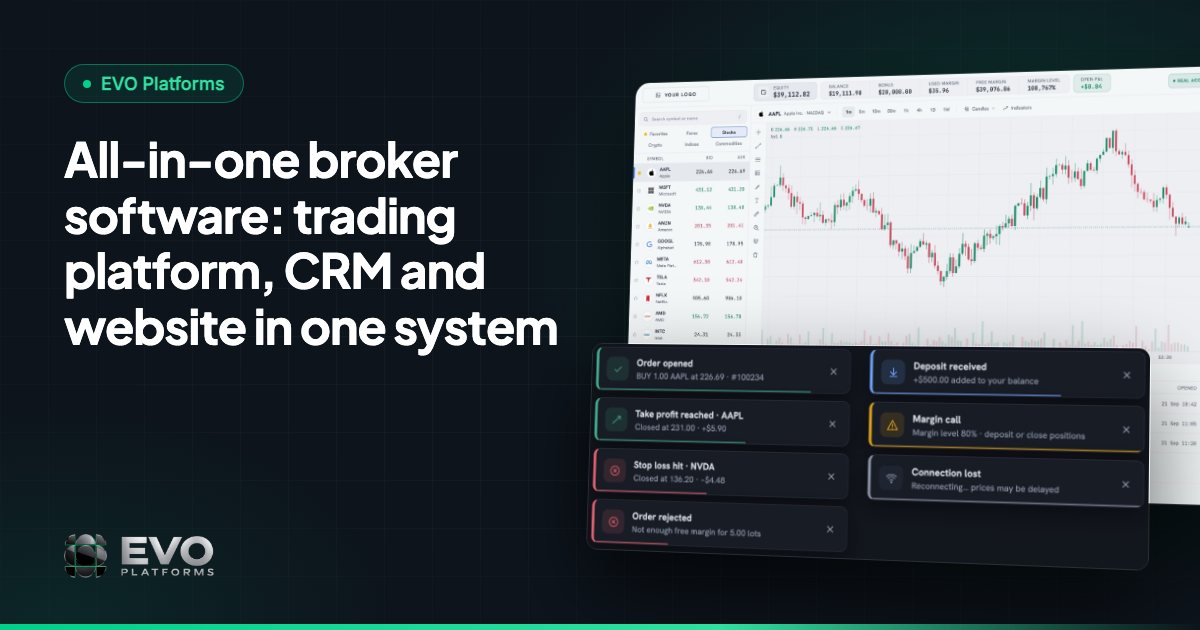
All-in-one broker software removes those handovers by putting the trading platform, CRM, back office and website in one system. This guide explains what it includes, what a split stack really costs, and when one system is the right choice — and when it is not.
Key takeaways
- All-in-one broker software puts the trading platform, CRM, back office, price feed and website in one system, under one contract.
- Split stacks lose time and leads in the handovers between vendors, and usually cost more in setup fees.
- B2Broker publishes $15,000–$50,000 to set up a full white label package plus a monthly fee, and $10,000–$30,000 for a website (as of November 2026).
- EVO includes WebTrader, CRM, back office, a 250+ symbol price feed and a full website from $2,500 per month, with no setup fee and no revenue share.
- Brokers that need a native mobile app, a desktop terminal or built-in A-book routing may be better served by a split setup.
What is all-in-one broker software?
All-in-one broker software is one system that covers everything a brokerage runs on: the platform clients trade on, the CRM your team sells from, the back office where you set risk, the price feed and the website where clients sign up. One vendor, one contract, one login for your staff.
| Piece | What it does | Who uses it |
|---|---|---|
| Trading platform (WebTrader) | Clients see prices and open and close trades | Clients |
| CRM | Leads, statuses, desks, agents, reports, affiliates | Sales, retention, marketing |
| Back office | Accounts, symbols, spreads, leverage, deposits and withdrawals | Dealing, finance, admins |
| Price feed | Real-time quotes for every symbol you offer | Platform and dealing desk |
| Website | Your brand's front door, where prospects sign up | Prospects and clients |
In a split setup, each row can come from a different vendor. In an all-in-one system, the pieces are built to work together, so a sign-up becomes a lead, a client and a funded account without exports or copy-paste.
What goes wrong when platform, CRM and website come from different vendors?
Mostly the gaps between them. Each tool can work well on its own, but every connection between two vendors is a place where data lags, breaks or gets copied by hand.
- Slow lead handover: sign-ups reach the CRM late or without their source, so agents call cold and marketing cannot tell which campaign worked.
- Manual account work: someone opens trading accounts or adjusts balances in a second system, which costs time and invites mistakes.
- Blame between vendors: when a deposit does not show on the platform, the CRM vendor blames the platform vendor and the other way round, while your client waits.
- Three bills and three contracts: each with its own renewal date, price rises and exit terms.
- More logins, more risk: every extra system is another set of passwords to protect and another place client data can leak.
Illustration: a broker with 1,500 sign-ups a month loses 1% of conversions to slow handovers. That is 15 FTDs (first-time depositors) a month. At a $400 average first deposit, $6,000 in first deposits goes to competitors every month, before you count what those clients would have traded.
How much does a split stack cost compared with one subscription?
A split stack usually costs more upfront and more each month, because every vendor charges its own setup and fee. Published ranges show how fast it adds up.
| Line | Published range | Source |
|---|---|---|
| White label platform package, setup | $15,000–$50,000 one-time | B2Broker |
| Platform and hosting | $7,000–$15,000+ a month | B2Broker |
| Website development | $10,000–$30,000 | B2Broker |
| CRM and back office, lean launch | $5,000–$25,000, or a monthly SaaS fee | Track360 |
| Building your own CRM | $120,000–$300,000+ over 4–8 months | B2Broker |
Illustration: take the low end of the B2Broker figures — $15,000 setup, $10,000 for a website and $7,000 a month — and year one comes to about $109,000, before any separate CRM. An all-in-one subscription with no setup fee at $2,500 a month comes to $30,000 for the year. Scope differs between vendors, so compare like for like, but the gap in upfront cash is hard to ignore.
That upfront cash matters most in month one, when it could be paying for ads and agents instead. Our breakdown of the cost to start a brokerage shows where technology sits in a full first-year budget.
What does EVO include in one system?
EVO Platforms gives each broker the trading platform, CRM, back office, price feed and website in one subscription, from $2,500 per month with no setup fee and no revenue share.
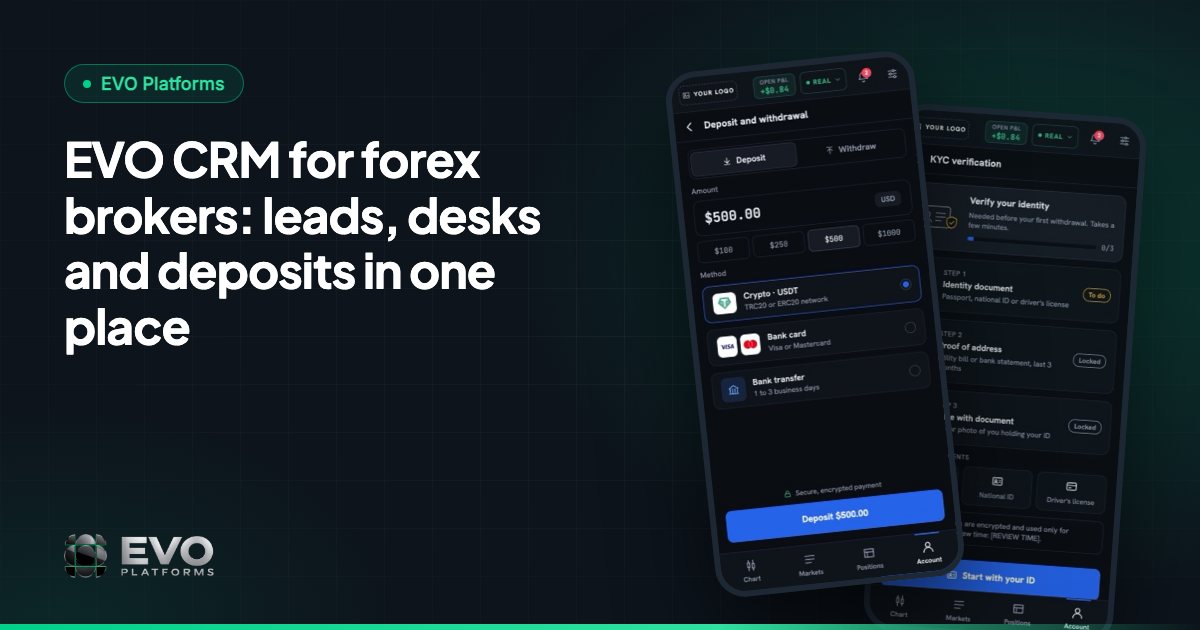
Each EVO broker runs on its own dedicated server, with servers and databases backed up on AWS. You get the white-label EVO WebTrader, EVO CRM with the back office, a real-time price feed with 250+ symbols (or plug in your own) and a full website built for your brand. Brokers go live in 24 hours, and the subscription can be paid in USDT.
Trading platform
- White-labelled in your colours, with light and dark themes.
- A simple order flow: Buy/Sell, open when price reaches a level you set, Take Profit and Stop Loss.
- Forex, stocks and CFDs, in the browser.
CRM
- Lead management, with custom lead statuses you add from inside the CRM.
- Desks for large teams, roles and reports.
- An affiliate system for partners who bring you clients.
Back office and risk
- Spreads per symbol, symbol limits and leverage per client.
- Margin call and stop out levels, plus suspended or disabled accounts.
- A dealing room for B-book brokers, available now. Risk groups are coming soon.
Website, languages and payments
- A full website built for each broker.
- English, Arabic, German and Spanish, plus any other language on request.
- Your own payment method through a custom integration, or local methods handled manually.
- More than one brand, each with its own branding. See running a multi-brand brokerage.
The full list is in EVO Platforms features.
Want to see the platform, CRM and website working together? Book a live demo with EVO and we will walk you through it on one call.
Talk to us on TelegramHow does one system change daily work for each team?
Every team works from the same client instead of chasing data across tools. Here is the difference by team:
| Team | Split stack | One system |
|---|---|---|
| Sales | Waits for leads to sync and checks another tool to see if a client funded | Works new leads by status and sees the client's account in the same place |
| Retention | Asks finance whether a deposit arrived | Sees deposits and account status next to the client |
| Marketing | Matches ad data to CRM exports in spreadsheets | Tracks lead sources and affiliates in reports |
| Dealing | Sets spreads in one tool and watches exposure in another | Sets spreads, leverage and limits where client positions are visible |
| Finance | Approves deposits over chat or email | Handles deposits and withdrawals in the back office |
| Management | Builds reports from three exports | Opens reports from one system |
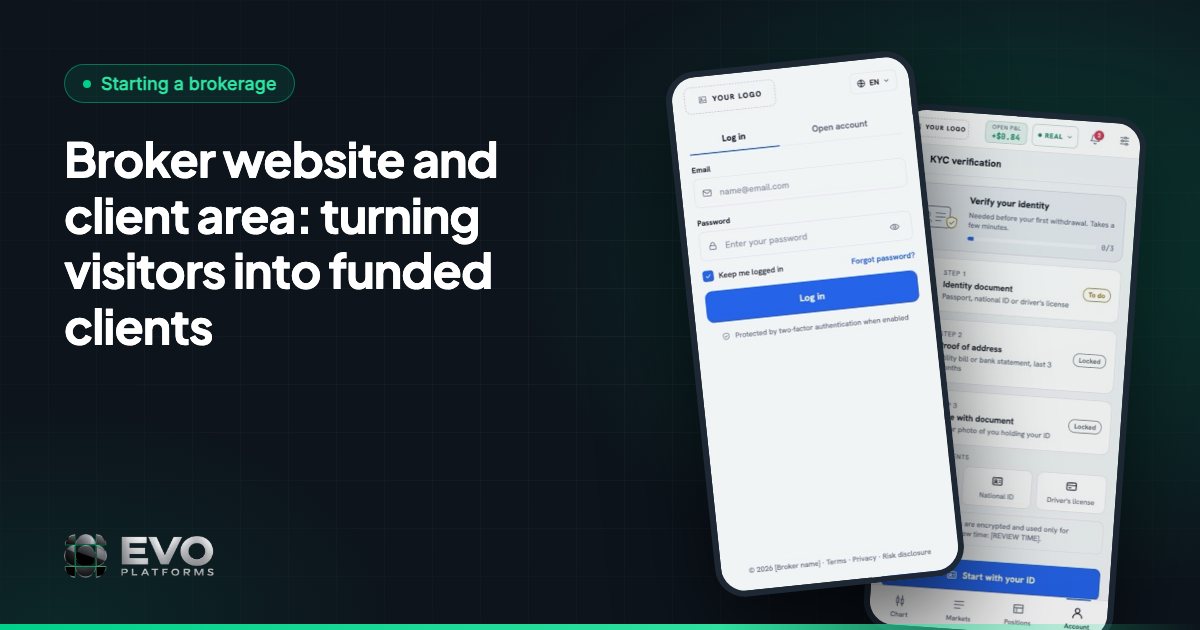
Fewer handovers also mean faster onboarding: a new agent learns one system, not three. Our guides to what a CRM does for a brokerage and the broker website and client area show each part in more detail.
Is all-in-one broker software right for every brokerage?
No. It fits most new brokers and many offshore and B-book operators, but some setups are better served by combining specialist tools.
| Usually a good fit | May need a different setup |
|---|---|
| New founders who want to launch fast on one budget line | Brokers whose clients insist on a desktop terminal or a native mobile app |
| Affiliates and introducing brokers launching their own brand | Brokers that need A-book routing to liquidity providers built into the platform |
| B-book brokers who want risk controls and a dealing room in the same system | Large brokers with deep custom connections already built around another platform |
| Operators running more than one brand | Teams that prefer a separate specialist vendor for each function |
If you sit in the right-hand column, a split stack may be worth the extra cost. If you are moving from MT5 or another platform, compare MT5 white label alternatives and read how to switch trading platform provider without losing clients.
EVO also builds custom features on request, so a missing piece does not always mean adding another vendor.
What should you check before buying all-in-one broker software?
Check that it is truly one system, not three resold products under one logo. These questions separate the two:
- 1One login? Can your team go from lead to account to deposit without switching systems?
- 2Who builds it? Is the code written in-house, so the vendor can fix bugs and add features itself?
- 3Where does it run? A dedicated server per broker, with backups and 24/7 monitoring?
- 4Is the price all-in? Platform, CRM, back office, feed and website in one fee, with no setup fee or revenue share?
- 5Can you plug in your own pieces? Your own price feed or payment method when you need it?
- 6How does support work? 24/7, in a direct channel, by people who can reach the servers?
EVO is built in-house to high code-quality standards. Each broker gets 24/7 support in its own dedicated Telegram group (@evoplatforms), with 24/7 server support and 24/7 uptime monitoring. CRM access is protected with an IP whitelist, activity logs and OTP/2FA.
Read how EVO builds its technology in-house, or see how you can launch a broker in 24 hours. Ready to compare plans? Visit EVO pricing or start with our new brokerage setup.
Frequently asked questions
What is all-in-one broker software?
One system that combines the trading platform, CRM, back office, price feed and broker website, sold by one vendor under one contract.
Is all-in-one cheaper than buying each piece separately?
Usually, mainly because you pay one subscription instead of several setup fees and monthly bills. Compare full written quotes, since scope differs between vendors.
Can I use my own price feed or payment provider with EVO?
Yes. Use EVO's real-time feed with 250+ symbols or plug in your own, and connect your own payment method through a custom integration or handle local methods manually.
Does EVO build the broker website too?
Yes. A full website is built for each broker in its own branding, alongside the WebTrader and CRM.
How long does it take to go live on EVO?
EVO brokers go live in 24 hours, with the platform, CRM, back office, price feed and website ready.
We build EVO — the white-label trading platform, CRM and back office for brokers — and have worked with brokerages since 2020.
Published: 8 min read
This article is for general information only and is not legal, tax or financial advice.
Go live in 24 hours — talk to us on Telegram
Trading platform, CRM, back office and price feed on your own server, in your brand. Plans start at $2,500 a month, with no setup fee and no revenue share.