Pips, lots and leverage explained for brokerage teams
A pip is the smallest standard price step, a lot is the unit of trade size, and leverage decides how much margin a position needs. Here is how all three fit together, explained for the people who run a brokerage.
 EVO PlatformsRisk & execution7 min read
A pip is the smallest standard price step in a currency pair, usually the fourth decimal place (0.0001), or the second decimal place (0.01) for yen pairs. A lot is the unit of trade size, and leverage is the ratio that decides how much margin a client must put up to open that size: at 1:100, the margin is 1% of the position.
These three words come up in almost every client conversation, from a first sales call to a support ticket about a closed position. This guide explains them for the people who work at a brokerage rather than for traders, and shows where each one appears in EVO WebTrader and the back office.
Key takeaways
- A pip is usually the fourth decimal place (0.0001), or the second (0.01) for yen pairs; a pipette or point is one tenth of a pip.
- A standard lot is 1.00, a mini lot 0.10 and a micro lot 0.01, and what one pip is worth grows in direct proportion to lot size.
- Leverage sets the margin a position needs (1% at 1:100) but does not change the pip value of a given lot size.
- Lot size and leverage together decide how fast a client's margin level falls toward margin call and stop out.
- In EVO, spreads and limits are set per symbol, leverage per client, and margin call and stop out run automatically.
Why your whole team should speak this language
Pips, lots and leverage are not only trader vocabulary. Every team in a brokerage uses them, and clients notice quickly when two people from the same company explain them differently.
- Sales agents explain account conditions, such as spreads and leverage, to new clients.
- Support agents answer questions like why a position was closed or why the margin changed.
- Retention agents review trading activity and talk to funded clients about their positions.
- Admins and risk staff set spreads, symbol limits and leverage in the back office.
A short shared glossary, used by every desk, removes most of that confusion. The sections below can serve as the base for one.
What is a pip?
A pip (short for *percentage in point* or *price interest point*) is the standard unit for measuring price movement. For most currency pairs it is the fourth decimal place. If EUR/USD moves from 1.0850 to 1.0851, it has moved one pip. For pairs quoted against the Japanese yen, a pip is the second decimal place, so USD/JPY moving from 150.20 to 150.21 is also one pip.
Most platforms quote one extra digit: a fifth decimal for most pairs and a third for yen pairs. That extra digit is a fractional pip, often called a pipette or a point, and ten of them make one pip. This is a common source of confusion. A spread of 12 points and a spread of 1.2 pips can be the same thing, so agree on which word your team uses.
| Instrument | Typical pip | One-pip move |
|---|---|---|
| Most forex pairs (EUR/USD, GBP/USD) | 0.0001 | 1.0850 → 1.0851 |
| Yen pairs (USD/JPY, EUR/JPY) | 0.01 | 150.20 → 150.21 |
| Metals, indices, crypto | Depends on how the symbol is defined | Check the symbol settings |
For metals, indices and crypto there is no single universal convention. What counts as a pip or a point depends on how each symbol is set up, so make sure support and sales use the same definition your platform shows.
Where pips show up: spreads, stops and results
- Spread. The gap between the bid and the ask is usually quoted in pips. In EVO, the spread is set and adjusted per symbol in the back office.
- Take profit and stop loss. Clients often think in distances, such as a stop loss 20 pips below the entry price.
- Results. Traders often measure performance in pips. What a pip is worth in the account depends on the lot size.
Because the spread is measured in pips, it is the first number most clients compare between brokers. For the commercial side of spreads, read how a brokerage earns from spread, commission and swap.
What is a lot in forex?
A lot is a standardized trade size. In forex, a standard lot (1.00) is 100,000 units of the base currency, the first currency in the pair. Smaller sizes are written as decimals of a standard lot:
| Name | Lot size | Share of a standard lot |
|---|---|---|
| Standard lot | 1.00 | 100% |
| Mini lot | 0.10 | 10% |
| Micro lot | 0.01 | 1% |
For metals, indices, crypto and stocks, one lot represents the contract size set for that symbol, which differs from forex. Your team should know where to find each symbol's specification before quoting it to a client.
The key rule is simple: what one pip is worth grows in direct proportion to the lot size. A 1.00 lot position that moves 10 pips has the same result as a 0.10 lot position that moves 100 pips. The exact value of a pip also depends on the quote currency of the pair and the currency of the client's account.
Leverage explained: it sets the margin, not the pip value
Leverage is written as a ratio, such as 1:100. It tells you what share of a position's value the client must hold as margin. The margin is the position value divided by the leverage figure:
| Leverage | Margin required (share of position value) |
|---|---|
| 1:10 | 10% |
| 1:30 | about 3.3% |
| 1:50 | 2% |
| 1:100 | 1% |
| 1:200 | 0.5% |
| 1:500 | 0.2% |
The most common client misunderstanding is that higher leverage means more profit per pip. It does not. The same lot size has the same pip value at any leverage. What leverage changes is how much of the account is tied up as margin, and so how much room the account has before a margin call. Higher leverage lets a client open bigger lots with the same equity, and that is where the risk grows.
Want to see these settings working on your own brand? We can have you live in 24 hours.
Talk to us on TelegramPutting it together: a worked example
Take two clients with the same equity, both trading EUR/USD at 1:100:
- 1Client A opens 0.10 lot. Client B opens 1.00 lot. B's position is ten times larger, so B's margin used is also ten times larger.
- 2The price moves 30 pips against both of them. B's floating loss is ten times A's, because the pip value follows the lot size.
- 3Margin level is equity divided by used margin, times 100%. B's equity falls faster while B's used margin is higher, so B's margin level drops much closer to the margin call level.
- 4If B's leverage were 1:50 instead of 1:100, B's used margin would double and the margin level would halve, moving B even closer to a stop out.
Same market, same move in pips, two very different outcomes. The difference comes from lot size and leverage working together. For the mechanics of the safety net, read margin call and stop out explained.
How to explain this to clients clearly
- Use pips for distances and spreads, lots for size and percent for margin and margin level.
- Repeat the core rule: the same lot size has the same pip value whatever the leverage.
- Never present higher leverage as better. Explain that bigger lots mean bigger swings in both directions.
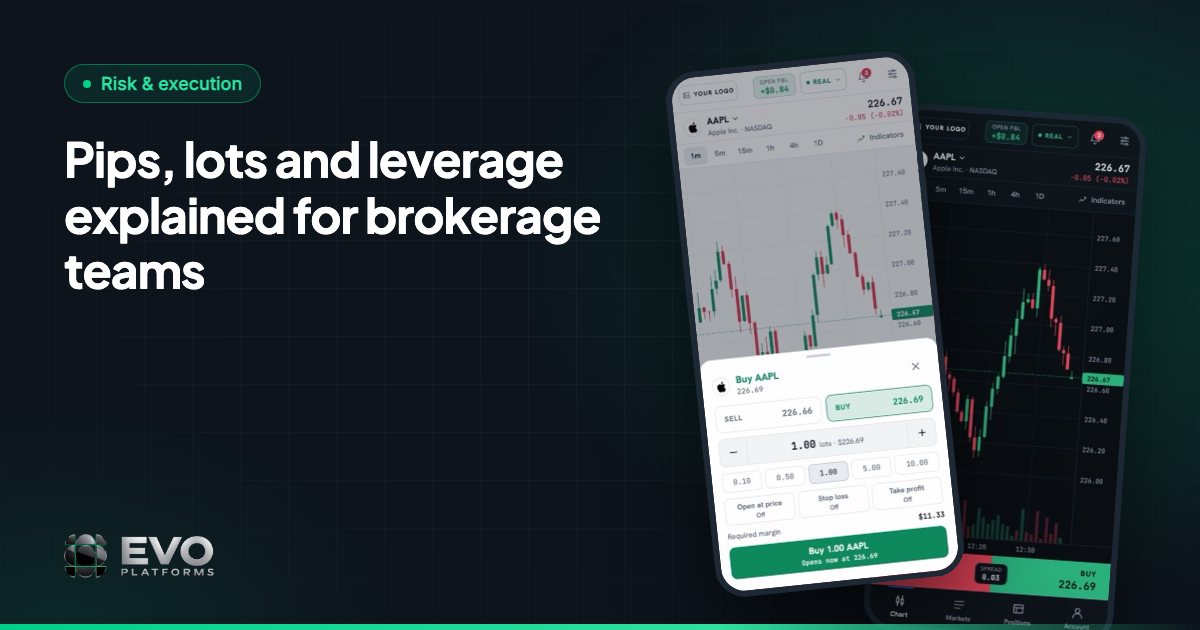
- Show clients the live bar in EVO WebTrader, which displays balance, equity, margin, free margin and P&L, so they can watch their own numbers.
- Keep one glossary for sales, retention and support, and update it when you add new symbols.
Pips, lots and leverage in EVO
In EVO, each of these concepts maps to a control in the back office, which is part of EVO CRM:
- Spread control: set and adjust the spread on every symbol.
- Limits per symbol: set volume and trading limits for each symbol.
- Leverage per client: give each client their own leverage.
- Margin call and stop out: your levels, handled automatically.
- Take profit and stop loss on every order, with full control over client positions.
- Suspended and disabled accounts when you need to stop trading or log-in on an account.
Clients see the result in EVO WebTrader: a simple Buy / Sell order box with take profit and stop loss, and the live balance, equity and margin bar. Risk groups, for managing clients per group, are coming soon. For a daily routine built on these controls, read risk management basics for brokers, and see EVO WebTrader features for the client side.
EVO plans start from $2,500 per month, with a flat monthly fee, no setup fee and no revenue share, and you can be live in less than 24 hours. See pricing, message us 24/7 on Telegram at @evoplatforms or contact us for a walkthrough.
Frequently asked questions
What is a pip in forex?
A pip is the standard unit of price movement in a currency pair. For most pairs it is the fourth decimal place (0.0001); for yen pairs it is the second decimal place (0.01). EUR/USD moving from 1.0850 to 1.0851 is a one-pip move.
What is a lot in forex?
A lot is a standardized trade size. A standard lot (1.00) is 100,000 units of the base currency, a mini lot is 0.10 and a micro lot is 0.01. For non-forex symbols, one lot equals the contract size set for that symbol.
Does higher leverage increase the value of a pip?
No. The same lot size has the same pip value at any leverage. Leverage only changes how much margin the position needs, so higher leverage lets a client open bigger positions with the same equity, which increases risk.
What is the difference between a pip and a point?
On most platforms a point, or pipette, is the fractional fifth decimal (third for yen pairs), and ten points make one pip. Agree on one term across your team so a spread of 12 points is not confused with 12 pips.
How is leverage set in EVO?
Leverage is set per client in the EVO back office, which is part of EVO CRM. Spreads and limits are set per symbol, and margin call and stop out are handled automatically at the levels you choose.
We build EVO — the white-label trading platform, CRM and back office for brokers — and have worked with brokerages since 2020.
Published: Updated: 7 min read
This article is for general information only and is not legal, tax or financial advice.
Go live in 24 hours — talk to us on Telegram
Trading platform, CRM, back office and price feed on your own server, in your brand. Plans start at $2,500 a month, with no setup fee and no revenue share.