MT5 white label alternatives for brokers in 2026
Why brokers are moving away from MT5 white labels, what an MT5 setup leaves out, the main alternatives in 2026 and how to move clients across without losing them.
 EVO PlatformsTrading platforms9 min read
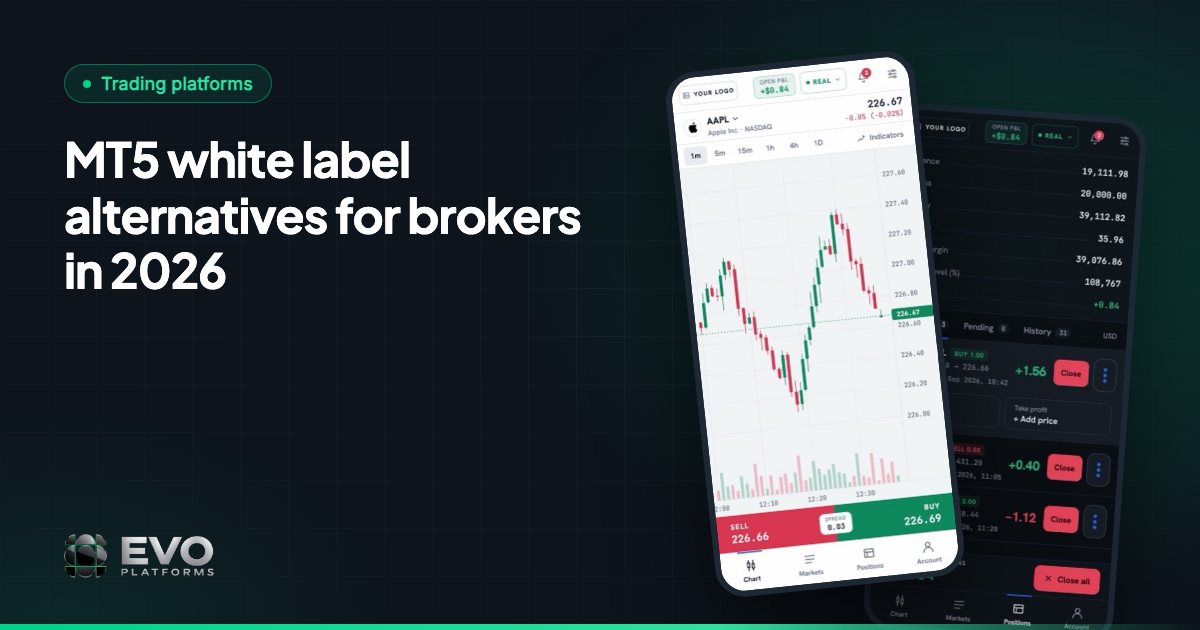
A founder asks a reseller for an MT5 white label and hears: no new white labels, but you can buy the full platform and host it yourself. Then come the CRM quote, the website quote and the payments quote.
If that sounds familiar, you need an MT5 white label alternative. This guide explains why brokers are switching, what to check in any alternative, the main options in 2026, and how to move clients across without losing them.
Key takeaways
- New MT5 white labels have been hard to get since MetaQuotes reportedly stopped issuing them in October 2022.
- An MT5 setup covers the trading engine; CRM, website, hosting and payments usually come from other vendors.
- cTrader, Match-Trader, DXtrade and TradeLocker are the main platform alternatives; of these, only TradeLocker publishes broker pricing (as of November 2026).
- EVO replaces the whole stack with one subscription from $2,500 per month, with no setup fee and no revenue share, live in 24 hours.
- Plan any switch around client communication and a short overlap period.
Why are brokers looking for an MT5 white label alternative?
Mostly because new MT5 white labels are hard to get and the total cost of an MT5 stack adds up. Industry media, including Finance Magnates and TradeInformer, reported that MetaQuotes stopped issuing new white labels in October 2022, which closed the cheapest route into MT5 for small brokers.
MT5's strengths are real: strong trader recognition, a large library of Expert Advisors (automated trading robots) and mature desktop and mobile apps. The reasons brokers look elsewhere are practical:
- Availability: renting a white label from a reseller is no longer the easy option it was.
- Hosting: MetaQuotes states that it does not offer MT5 as SaaS; brokers run it on their own hardware.
- Total cost: the platform is one bill; CRM, website and payment connections usually come from other vendors.
- Speed: coordinating several vendors stretches a launch over weeks.
- Fit: many B-book brokers want risk tools and the CRM in the same system as the platform.
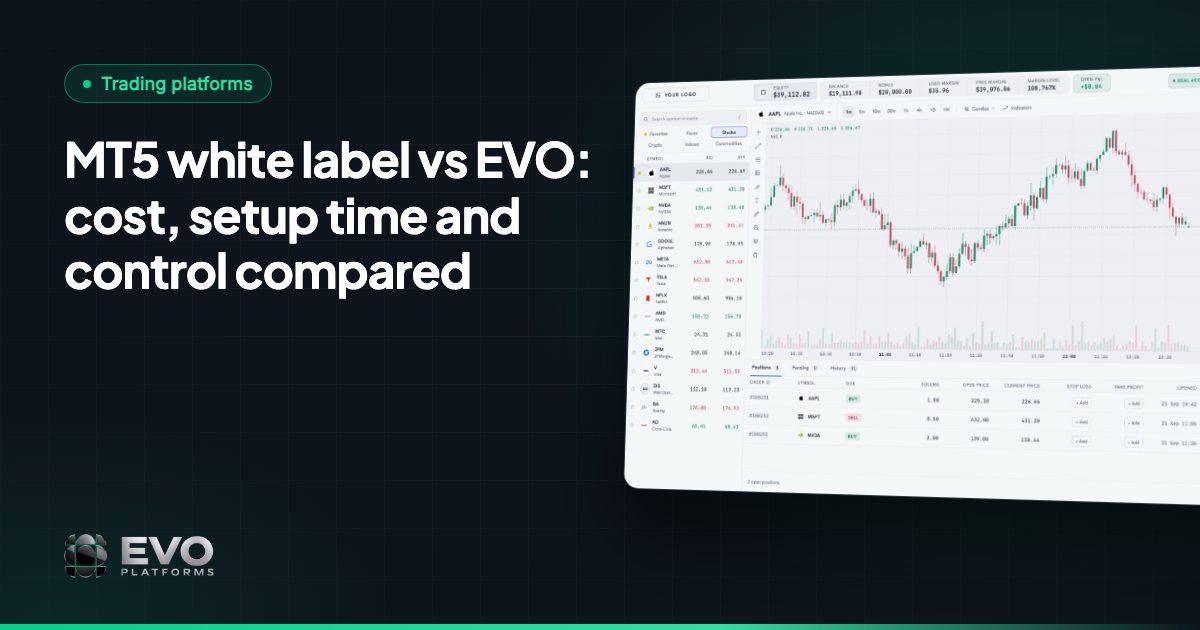
For a side-by-side view of cost and setup time, read MT5 white label vs EVO.
What does an MT5 setup include, and what is missing?
MT5 gives you the trading engine, manager tools and trader terminals — not the CRM, website or payment flow that turn visitors into funded clients. MetaQuotes lists trade and history servers, a manager terminal with role-based access, gateways to liquidity providers, APIs, and desktop, web and mobile terminals (as of November 2026 — check their site).
| Part of the business | In an MT5 package? | Usually comes from |
|---|---|---|
| Trading server and terminals | Yes | MetaQuotes |
| Manager and risk tools | Yes, the manager terminal | MetaQuotes, plus third-party plugins |
| Hosting and server operations | No, you host it | Your team or a hosting partner |
| CRM and lead management | No | A separate CRM vendor |
| Broker website | No | A web agency |
| Price feed and liquidity | Through gateways | A liquidity or data provider |
| Deposits to trading accounts | No | Your CRM vendor or custom development |
Each extra vendor adds a monthly fee and a connection that can break. That is the real comparison: not MT5 against another platform, but an MT5 stack against an alternative stack.
What should you check in any MT5 alternative?
Ask every vendor the same eight questions and get written answers: availability, pricing model, included modules, launch time, client experience, branding, risk tools and hosting.
| Criterion | Why it matters | Question to ask the vendor |
|---|---|---|
| Availability | No point planning around a platform you cannot get | Can you onboard my brokerage this month? |
| Pricing model | Revenue share and per-account fees grow with you | Is there a setup fee, a revenue share or a per-account charge? |
| Included modules | A separate CRM and website add cost and connection work | Are CRM, back office, website and price feed included? |
| Time to launch | Every week of delay pushes back your first deposits | How many days from payment to live? |
| Client experience | Traders judge you by the platform | Can I test web and mobile with a demo account today? |
| Branding | Clients should see your brand, not the vendor's | Is it fully in my colours, logo and domain? |
| Risk tools | B-book brokers need control over exposure | Can I set spreads per symbol, leverage per client and stop out levels? |
| Hosting and data | Your client data is your business | Do I get my own dedicated server, and how is it backed up? |
Also ask what happens to your data if you leave. A vendor that answers that clearly usually answers everything else clearly too.
What are the main MT5 white label alternatives?
The established alternatives are cTrader, Match-Trader, DXtrade and TradeLocker, plus all-in-one systems such as EVO. The facts below come from each vendor's own website (as of November 2026 — check their site).
cTrader
Spotware's cTrader is the closest like-for-like MT5 alternative for active traders: broker-branded web, desktop and mobile apps, built-in copy trading and algo trading, and servers hosted by Spotware. CRM, payments and back office connect through APIs, and pricing is not published. Compare: EVO vs cTrader white label.
Match-Trader
Match-Trade Technologies sells Match-Trader as a white-label package with web, mobile and desktop access, a Client Office and CRM, a payment gateway, liquidity and data feeds, and a MAM application for money managers. It works with registered companies only and does not publish prices on its white-label page. Compare: EVO vs Match-Trader.
DXtrade
Devexperts has offered DXtrade as a hosted SaaS platform for FX and CFD brokers since 2020, with limits, margins and spreads configurable per instrument, group or client, and coverage that extends to other asset classes depending on the version. Pricing is quote-based. Compare: EVO vs DXtrade.
TradeLocker
TradeLocker publishes a broker Starter plan at $5,000 per month with 1,000 live accounts, no setup fee and hosting included, and says launches typically take about 10 days. Its FAQ notes that it does not support full customisation to individual brand identities. Compare: EVO vs TradeLocker.
Should you build your own platform instead of MT5?
For most brokers, no: building first is slower and far more expensive than launching on a white label and adding custom features later. A proprietary platform means a dealing engine, price feed handling, a risk engine, client apps, a CRM, security, hosting and an engineering team you pay every month.
- Pros: full ownership, unique features, no platform vendor.
- Cons: high upfront cost, a build commonly measured in many months, and a permanent engineering payroll.
- Risk: a bug in pricing or margin logic hits client balances and your reputation directly.
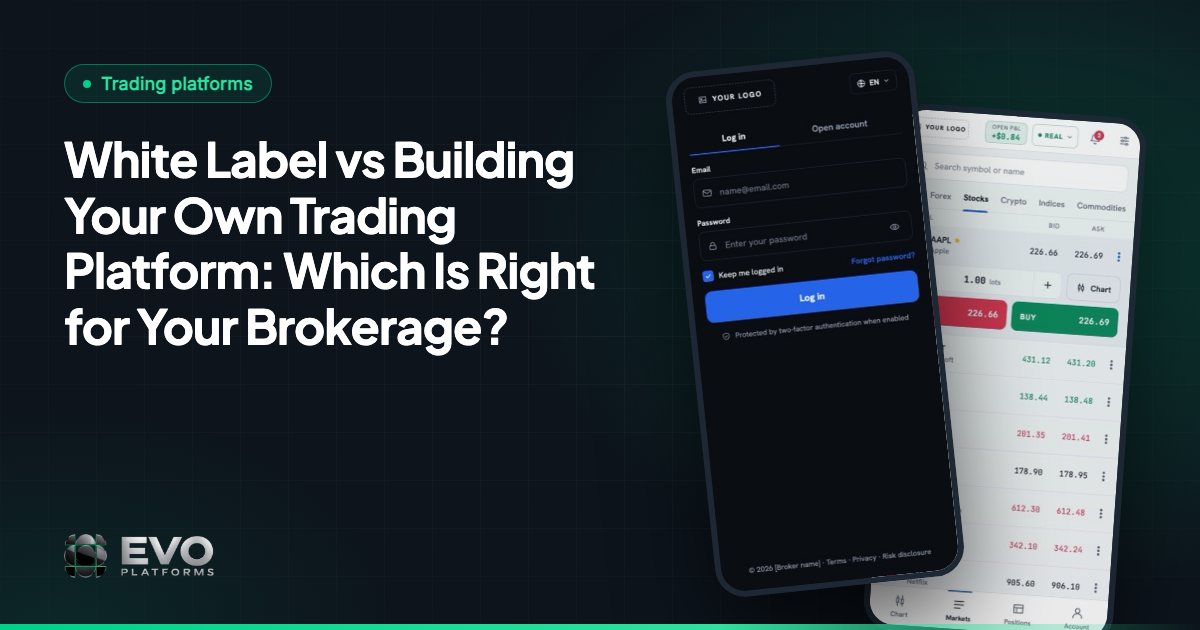
We cover this decision in white label vs building your own trading platform. EVO builds custom features on request, which is often the middle path: launch now, add what makes you different later.
Stuck waiting on an MT5 white label? Talk to EVO and see a branded platform, CRM and website running before you commit.
Talk to us on TelegramHow does EVO work as an MT5 white label alternative?
EVO replaces the whole MT5 stack — platform, CRM, back office, price feed and website — with one subscription, live in 24 hours. Plans start at $2,500 per month, with no setup fee and no revenue share, and you can pay in USDT.
Each broker runs on its own dedicated server, backed up on AWS, with 24/7 server support and uptime monitoring. The EVO WebTrader runs in the browser in your colours, with light and dark themes and a simple order flow: Buy/Sell, open when the price reaches a level, Take Profit and Stop Loss, across forex, stocks and CFDs. EVO's own price feed streams 250+ symbols in real time, or you plug in your own. B-book brokers get a dealing room, spreads per symbol, symbol limits, leverage per client and margin call/stop out controls.
- CRM included: lead management with custom statuses, desks for large teams, roles, reports and an affiliate system.
- Security: IP whitelist for CRM access, activity logs and OTP/2FA.
- Website: a full website built for your brand.
- Languages: English, Arabic, German and Spanish, plus any other on request.
- Support: 24/7, in a dedicated Telegram group for each broker.
How do you move from MT5 to an alternative without losing clients?
Plan the switch like a product launch: map your settings, tell clients early and run both systems for a short overlap. Most client losses in a migration come from poor communication, not from the new platform.
- 1Map your setup: list symbols, spreads, leverage, groups and swap settings so they can be rebuilt on the new platform.
- 2Agree the account move: decide with the new provider how client accounts, balances and open positions will be moved or closed.
- 3Brief your desks: sales and retention agents should know the new platform before clients ask about it.
- 4Tell clients early: email, Telegram and WhatsApp, with a date, a short video and a support contact.
- 5Run an overlap: keep MT5 open for closing positions while new trades go to the new platform.
- 6Watch the first week: track logins, deposits and support tickets every day.
Illustration: a broker with 600 funded clients that loses 10% in a messy migration loses 60 accounts. At an illustrative $400 average monthly revenue per funded client, that is $24,000 a month walking out of the door — far more than any platform fee.
We cover the full process in how to switch trading platform provider, and the dealing side in B-book risk management.
Which MT5 alternative fits your brokerage?
Pick by who your clients are and how you run your book:
| Your situation | Option that often fits |
|---|---|
| Clients demand Expert Advisors and you can host your own servers | Stay on MT5 with a full platform package |
| Active, algo and copy traders | cTrader |
| Platform plus client office from one vendor | Match-Trader |
| Multi-asset depth and heavy configuration | DXtrade |
| A modern charting front end, and you already run a CRM | TradeLocker |
| New or B-book broker, one bill, live in 24 hours | EVO Platforms |
Test with real users, get every fee in writing, and compare the full stack, not just the platform. See EVO pricing or the white label solution for exactly what is included.
Frequently asked questions
What is the best MT5 white label alternative?
It depends on your clients. cTrader is closest for active and algo traders; Match-Trader and DXtrade suit brokers who want more modules or asset classes; EVO suits new and B-book brokers who want platform, CRM and website in one subscription.
Can I still get an MT5 white label in 2026?
It is much harder than before. Industry media reported that MetaQuotes stopped issuing new white labels in October 2022. The main MT5 route now is buying the platform directly and hosting it yourself.
Is there an MT4 alternative that runs in the browser?
Yes. EVO WebTrader, Match-Trader, DXtrade and TradeLocker all offer web trading. EVO is browser-only, so clients trade on desktop or phone with nothing to install.
Will my clients' Expert Advisors work on an alternative?
MT5 Expert Advisors only run on MetaTrader. cTrader has its own algo trading with cBots, and EVO WebTrader does not run EAs. Check what share of your volume comes from EAs before you switch.
How long does it take to switch from MT5?
EVO goes live in 24 hours; the full migration depends on how you move clients and balances. Plan a short overlap period and tell clients early.
How much does an MT5 alternative cost?
Most vendors quote on request. TradeLocker lists $5,000 per month for its broker Starter plan (as of November 2026 — check their site). EVO starts at $2,500 per month with no setup fee and no revenue share.
We build EVO — the white-label trading platform, CRM and back office for brokers — and have worked with brokerages since 2020.
Published: 9 min read
This article is for general information only and is not legal, tax or financial advice.
Go live in 24 hours — talk to us on Telegram
Trading platform, CRM, back office and price feed on your own server, in your brand. Plans start at $2,500 a month, with no setup fee and no revenue share.